Choosing the right residential care setting for a loved one is one of the most important decisions a family can make. With several types of care available - each designed for a different level of medical complexity and daily support - it is easy to feel overwhelmed by the options. This guide explains the full spectrum of residential care options in Washington State for 2026, from independent living to skilled nursing facilities. We will help you match your loved one's needs to the right environment, with a special focus on high-acuity care for those with complex medical conditions.
The Spectrum of Residential Care Options
Residential care is not a single product. It is a continuum, ranging from minimal-support community living to round-the-clock skilled medical care. Understanding where your loved one falls on this spectrum is the first step toward finding the right home.
1. Independent Living Communities
Best for: Active seniors who need little to no daily assistance but want a maintenance-free lifestyle, social activities, and a sense of community.
Independent living communities - also called retirement communities or 55+ apartments - offer private apartments or cottages with shared amenities such as dining rooms, fitness centers, and organized social events. Residents manage their own care independently. These communities are not licensed to provide personal care or medical supervision.
- Typical resident: Mobile, manages own medications, drives or uses community transportation
- Staff support: Minimal - concierge, activities coordinator, maintenance
- Cost range: $2,500 - $5,000 per month
- Regulation: Generally not licensed as healthcare facilities
2. Assisted Living Facilities
Best for: Seniors who need help with some activities of daily living (ADLs) but do not require intensive medical supervision.
Assisted living facilities are typically apartment-style buildings housing 40 to more than 200 residents. They provide meals, housekeeping, medication reminders, and assistance with bathing, dressing, and toileting. Staff work in rotating shifts, and a nurse may be available during certain hours.
- Typical resident: Needs help with 1-3 ADLs, stable chronic conditions, minimal wandering risk
- Staff support: Caregivers on shift; nurse on call or part-time
- Cost range: $4,000 - $8,000 per month
- Regulation: Licensed by DSHS under Chapter 388-78A WAC
3. Adult Family Homes (AFHs)
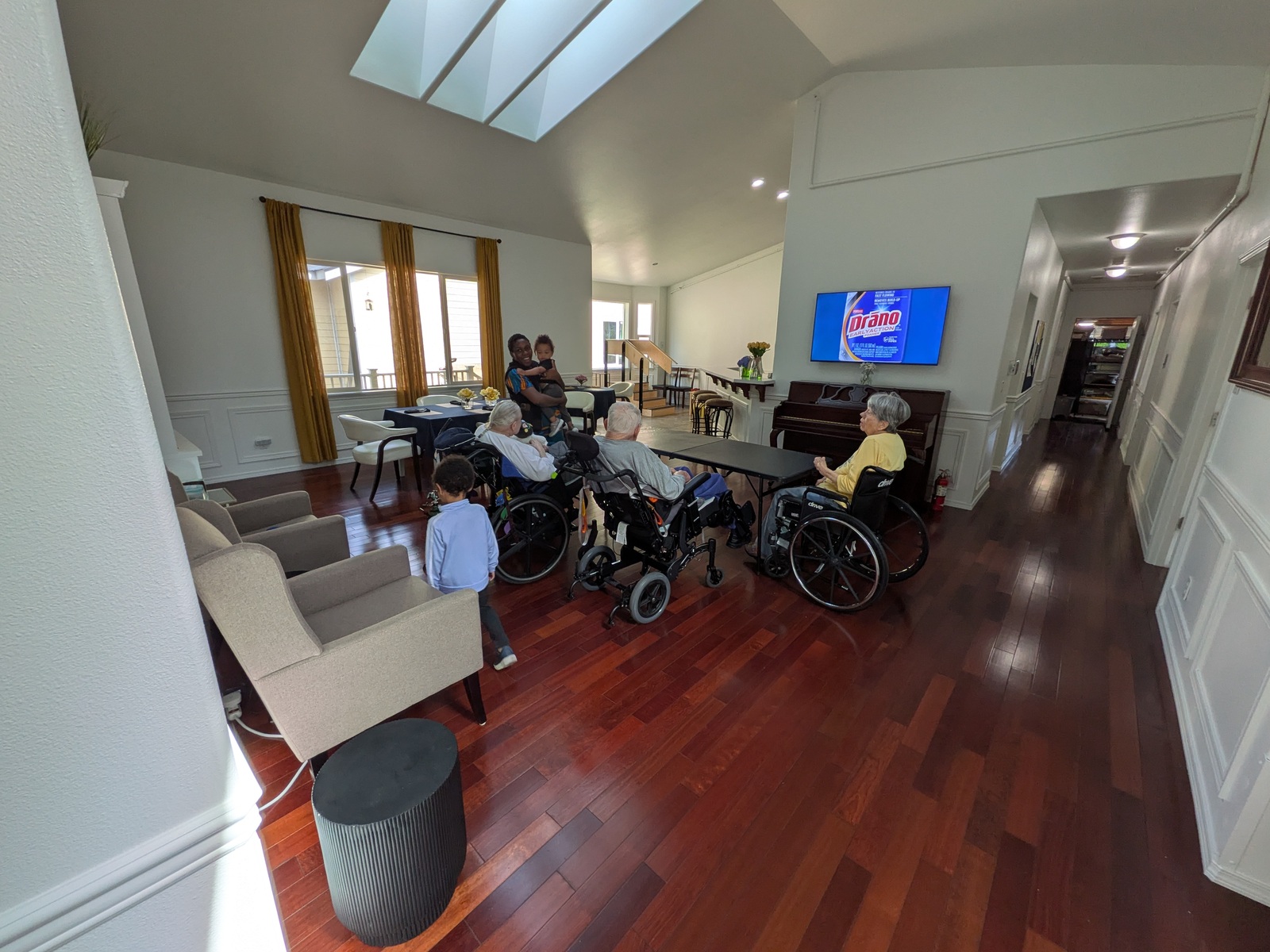
Best for: Seniors who want personalized, relationship-based care in a real home environment, including those with moderate to high medical needs.
Adult family homes are licensed residential houses in standard neighborhoods, serving up to six residents. Care is provided by live-in or overlapping caregivers who develop deep familiarity with each resident's routines and preferences. Many AFHs are nurse-owned, enabling them to manage complex conditions that standard assisted living cannot accommodate.
At Edmonds Villa, we are an RN-owned and operated high-acuity adult family home serving residents with conditions ranging from dementia to dialysis care and complex neurological disorders.
- Typical resident: Needs help with 2-6 ADLs, may have complex medical conditions requiring nursing oversight
- Staff support: Consistent caregivers; RN supervision in nurse-owned homes
- Cost range: $4,500 - $9,000 per month
- Regulation: Licensed by DSHS under RCW 70.128
4. Memory Care Communities
Best for: Individuals with Alzheimer's disease, dementia, or other cognitive impairments who need a secured, structured environment with specialized programming.
Memory care units are secured environments - either standalone or as a wing within assisted living - designed to prevent wandering and reduce confusion. Staff receive specialized training in dementia care, and activities are structured around cognitive stimulation and routine.
- Typical resident: Moderate to advanced dementia, wandering risk, requires redirection and structured routine
- Staff support: Dementia-trained caregivers; nurse oversight
- Cost range: $5,500 - $10,000 per month
- Regulation: Covered under assisted living or nursing home licensing
5. Skilled Nursing Facilities (Nursing Homes)
Best for: Individuals who require 24/7 skilled nursing care, rehabilitation after hospitalization, or management of unstable medical conditions.
Skilled nursing facilities (SNFs) provide the highest level of medical care outside a hospital. Registered nurses are on staff around the clock, and physicians, physical therapists, and other specialists are regularly involved. These facilities serve both short-term rehab patients and long-term residents with chronic, complex conditions.
- Typical resident: Needs 24/7 nursing, post-hospital rehab, multiple complex diagnoses, or end-of-life care
- Staff support: RNs and LPNs 24/7; physicians, PT/OT, speech therapy
- Cost range: $8,000 - $14,000 per month
- Regulation: Licensed by DSHS and certified by Centers for Medicare & Medicaid Services (CMS)
Matching Care Level to Medical Complexity
The biggest mistake families make is choosing a setting based on amenities or location before evaluating medical need. Use this framework to match your loved one's condition to the appropriate level of care:
| Care Need Level | Indicators | Recommended Setting |
|---|---|---|
| Level 1 - Minimal | Fully mobile, self-medicates, no chronic condition management needed | Independent living |
| Level 2 - Low | Needs help with 1-3 ADLs, stable medications, occasional reminders | Assisted living or AFH |
| Level 3 - Moderate | Needs help with 3+ ADLs, multiple daily meds, chronic conditions (diabetes, COPD, hypertension) | Adult family home (standard or high-acuity) |
| Level 4 - High | Complex medical needs (dialysis, tube feeding, wound care, Parkinson's), requires RN oversight | High-acuity AFH or skilled nursing |
| Level 5 - Intensive | 24/7 skilled nursing, ventilator, unstable vitals, post-hospital recovery, end-of-life | Skilled nursing facility |
When to Choose a High-Acuity Adult Family Home
For families whose loved one falls into Level 3 or Level 4 - moderate to high medical complexity - a high-acuity adult family home often represents the ideal balance. You get the personalized, homelike environment of an AFH with the clinical capability usually found only in skilled nursing.
High-acuity adult family homes like Edmonds Villa provide:
- Registered nurse oversight and direct care
- Management of complex conditions including dialysis, Parkinson's, neurological disorders, and bariatric care
- Specialized equipment such as hospital beds, lifts, oxygen, and suction
- Detailed clinical protocols and medication management
- Coordination with hospice, home health, and primary care providers
This option is often more cost-effective than skilled nursing - typically $9,000 to $12,000 per month versus $8,000 to $14,000+ - while providing more individualized attention and a warmer daily environment. Learn more about our approach to high-acuity care.

How to Evaluate a Residential Care Home
Once you have identified the type of care your loved one needs, use these criteria to evaluate specific homes and facilities:
- Verify licensing. Use the DSHS Residential Care Facility Search to confirm active license status. If a home cannot produce a valid DSHS license number, it is not legally permitted to provide personal care.
- Review inspection reports. Ask for the most recent DSHS inspection and any complaint investigation results. Look for patterns - a single citation is less concerning than the same issue appearing year after year.
- Assess staffing. What is the caregiver-to-resident ratio? Is a registered nurse on staff or on call? What is staff turnover like? Familiar faces are a sign of a healthy workplace.
- Tour during activity hours. Visit when residents are awake and active - not during naptime. Observe how staff interact with residents. Is the tone warm and respectful? Are call lights answered promptly?
- Ask about medical capabilities. Can the home manage your loved one's specific conditions? What training does the staff have for complex needs? Is a physician or nurse practitioner involved in care planning?
- Understand the cost structure. What is included in the base rate? What is billed as extra? Are there Medicaid/COPES options? Can the home accommodate VA benefits or long-term care insurance?
Paying for Residential Care in Washington State
Financing residential care is often the most stressful part of the process. Here is a summary of payment sources available in Washington:
- Private pay - Personal savings, Social Security income, pension, retirement accounts
- Medicaid COPES waiver - Covers personal care services for qualifying residents in AFHs and assisted living; room and board paid through monthly income. Learn more from DSHS Medicaid Waiver Programs.
- Community First Choice (CFC) - Provides personal care coverage for eligible Medicaid recipients
- VA Aid and Attendance - Available to qualifying veterans and surviving spouses to supplement care costs
- Long-term care insurance - Policy terms vary; check whether your plan covers AFHs, assisted living, and skilled nursing
- Medicare - Limited to short-term skilled nursing stays post-hospitalization; does not cover custodial long-term care
Why Families Choose Edmonds Villa
Families who come to contact us at Edmonds Villa are often at a crossroads: their loved one's needs have grown beyond what assisted living or a standard AFH can provide, but skilled nursing feels too institutional and expensive. We fill that gap with RN-led, high-acuity care in a warm, residential Edmonds home.
Our residents benefit from a high staff-to-resident ratio, consistent caregivers who know them personally, and the clinical expertise of an on-site registered nurse - all in an ordinary house on a quiet street. We accept private pay, COPES Medicaid, and VA benefits, and we work with families to create a care plan that truly fits.
Ready to explore your options? We invite you to see the difference high-acuity adult family home care can make. Contact us to schedule a visit or speak with our team.
Frequently Asked Questions About Residential Care Options
What are the main types of residential care options available?
The main residential care options include independent living communities (for active seniors who need minimal support), assisted living facilities (40-200+ residents with daily assistance available), adult family homes (2-6 residents in a house setting for personalized care), memory care units (secured environments for dementia and Alzheimer's), and skilled nursing facilities (24/7 medical care for complex conditions). Each level corresponds to a different degree of medical complexity and daily support needs.
How do I know which residential care option is right for my loved one?
Start by assessing your loved one's current care needs across four dimensions: mobility (can they transfer and walk safely?), medication management (how many daily meds and are there injections?), personal care (do they need help bathing, dressing, toileting?), and medical complexity (are there chronic conditions requiring monitoring?). A person who is independent with light housekeeping needs may thrive in independent living, while someone with multiple chronic conditions and 24/7 nursing needs may require a skilled nursing facility or a high-acuity adult family home.
What's the difference between an adult family home and assisted living?
Adult family homes (AFHs) are residential houses licensed for up to six residents, providing care in a homelike setting with consistent caregivers who know each resident personally. Assisted living facilities are larger, apartment-style buildings housing 40-200+ residents with shift-based staff. Adult family homes typically offer more individualized attention, a quieter environment, and can often accommodate higher-acuity needs than standard assisted living. Both are regulated by Washington State DSHS.
Does Medicare or Medicaid pay for residential care in Washington State?
Original Medicare does not cover long-term custodial care but may cover short-term skilled nursing stays after a hospital admission. Washington State's Medicaid COPES waiver can cover personal care services in adult family homes and assisted living for qualifying residents, though room and board costs are typically paid through monthly income. The Community First Choice (CFC) program also provides coverage. Veterans may qualify for VA Aid and Attendance benefits. Long-term care insurance policies may also apply depending on the policy terms.
What is high-acuity care in a residential setting?
High-acuity care refers to the ongoing clinical management of complex medical conditions that go beyond basic assistance with daily living. This includes dialysis support, tube feeding, ventilator care, complex wound management, Parkinson's disease management, bariatric care, neurological condition monitoring, and hospice support. High-acuity care requires trained nursing oversight, specialized equipment, and detailed clinical protocols - services most standard residential care settings cannot provide.
What should I look for when touring a residential care home?
When touring, observe the caregiver-to-resident ratio during your visit. Look at cleanliness and odor control, which are strong indicators of quality care. Ask about staff training, turnover rates, and whether a registered nurse is on staff or on call. Notice how staff interact with residents - is the atmosphere warm and respectful? Ask to see the most recent DSHS inspection report and verify the license status using the DSHS Residential Care Facility Search online tool. Trust your instincts about the environment and the people.
What is the average cost of residential care in Washington State in 2026?
Monthly costs vary significantly by care level: independent living typically ranges from $2,500 to $5,000, assisted living from $4,000 to $8,000, adult family homes from $4,500 to $9,000, memory care from $5,500 to $10,000, and skilled nursing facilities from $8,000 to $14,000. High-acuity care homes with RN ownership and advanced clinical capabilities sit at the upper end. Geographic location within Washington also affects pricing, with King and Snohomish counties generally commanding higher rates.
Navigating Residential Care with Confidence
Understanding the full spectrum of residential care options is the first step toward making a decision that serves your loved one's needs, preferences, and quality of life. From independent living to skilled nursing, each level of care exists to match a specific degree of medical complexity and daily support requirement. The right choice is the one that fits your loved one's actual condition, not the one with the most amenities or the most convenient location.
A high-acuity adult family home like Edmonds Villa offers a rare combination: the clinical capability to manage complex medical conditions and the warmth of a genuine home environment. If your loved one falls in the moderate-to-high complexity range, this option deserves serious consideration.