When families first hear the phrase Parkinson's care home, most picture one of two things: a memory care wing with a sign out front, or a generic residential facility that happens to accept residents with Parkinson's disease. In reality, neither of those is necessarily a Parkinson's care home at all. A genuine Parkinson's care home is a residential setting that builds its entire model of care around the disease — its medication schedules, its fall risks, its movement fluctuations — rather than simply recording the diagnosis at admission and proceeding as usual.
Parkinson's disease affects roughly one million Americans, and that number is climbing as the population ages. Yet most care homes operate without any formal protocol for the condition. A standard caregiver may know how to help with dressing and bathing, but may not know that a resident's levodopa must be given at the same time every day, or what to do when the resident freezes mid-step on the way to the bathroom. That gap — between a home that can accept a Parkinson's resident and a home that can actually care for one — is the single most important thing to understand when you begin your search.
This guide explains what a Parkinson's care home actually is, the clinical features that separate real specialization from generic care, and the practical steps families can take to evaluate a facility — including the questions to ask on a tour. We'll use Edmonds Villa, an RN-owned high-acuity adult family home in Edmonds, Washington, as a working example of what genuine Parkinson's specialization looks like in practice.
What a Parkinson's Care Home Is (And What It Is Not)
At its simplest, a Parkinson's care home is a licensed residential setting that provides housing, meals, personal care, and medication management to people living with Parkinson's disease — with a care plan built around the condition's specific demands. In Washington State, the license types that can provide this care are adult family homes and assisted living facilities, both regulated by the Department of Social and Health Services (DSHS).
Because "Parkinson's care home" is not a legal license category — it's a description of capability — the label tells you less than the care plan does. A home that advertises Parkinson's care must demonstrate it through training, staffing, and protocols, not just through the fact that its marketing page mentions the disease. That is why families get into trouble: every facility will say it can care for someone with Parkinson's, but very few have built the clinical infrastructure the disease requires.
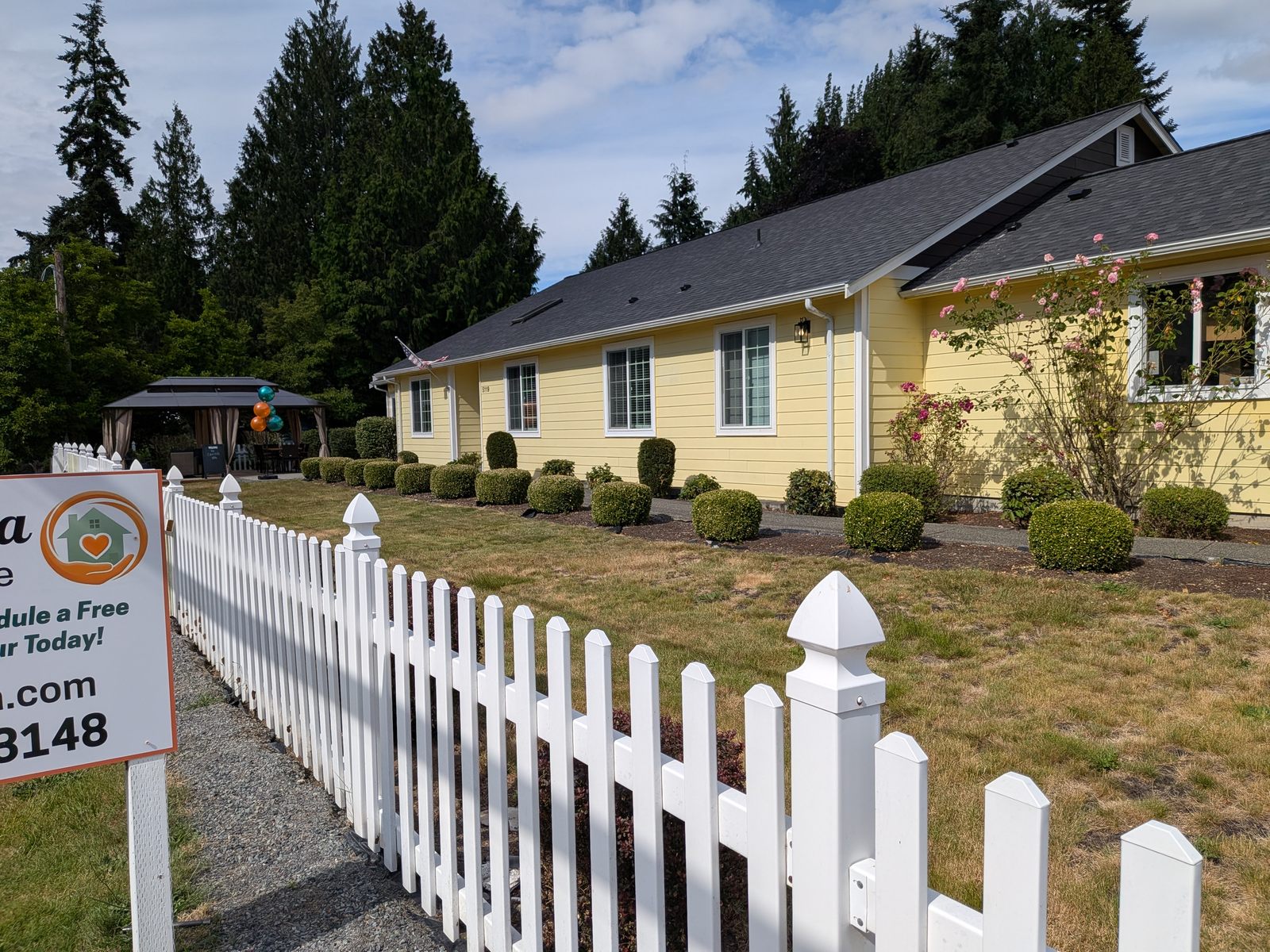
An adult family home that genuinely specializes in Parkinson's, like Edmonds Villa, runs as a small, high-acuity residence in an ordinary neighborhood, where an RN supervises care and every caregiver understands how the disease changes over time. The six-resident scale matters: it means consistent caregivers who learn each resident's medication windows, walking patterns, and daily rhythms — knowledge that no rotating staff in a large facility can match.
Why Parkinson's Care Is Different From General Elder Care
Parkinson's disease is not dementia, heart disease, or generalized frailty — although a resident may have several of those at once. It is a neurological movement disorder with three features that are unique to it, and each one reshapes how care has to be delivered:
- Medication timing is life-changing. Levodopa and related medications work on a strict schedule, and their benefits last only a limited window. Late medication can mean the difference between a resident who walks to the table and one who cannot stand.
- Falls are the leading serious complication. People with Parkinson's fall more often, and those falls more often result in fractures and hospital stays, than nearly any other group of older adults.
- Symptoms fluctuate hour to hour. A resident may be fully mobile at 10 a.m. and frozen in place by 11 a.m. as medication wears off. Care decisions have to account for that changing baseline.
General elder care is built around comfort and safety at a steady baseline. Parkinson's care has to be built around a moving baseline, because the disease itself changes a person's abilities hour by hour. The National Institute of Neurological Disorders and Stroke describes Parkinson's as a progressive disorder of the nervous system, and progressive is the key word — the care model has to progress with it.
The Clinical Features That Define Genuine Parkinson's Care
When you visit a facility, these are the clinical features that tell you whether it truly specializes in Parkinson's disease or simply accepts Parkinson's residents. They are the difference between custodial care and skilled care.
Medication Timing and Delivery
Parkinson's medications, particularly levodopa, have a limited window of effectiveness, and the disease's symptoms return when that window closes. A delay of even 30 minutes can mean the difference between walking independently to the bathroom and needing two caregivers. A specialized home schedules the entire day around medication times, prepares medications exactly as prescribed, and trains staff to recognize when a dose has worn off — and to document and report it rather than assuming the behavior is simply "having a bad day."
Fall Prevention Built Into Daily Life
Falls are the leading cause of serious injury and hospitalization among people living with Parkinson's. Real fall prevention is not a grab bar in the shower and a warning sign in the hallway. A Parkinson's care home assesses gait and balance regularly, times transfers to medication "on" periods when mobility is strongest, clears walking paths of clutter, uses adaptive equipment, and supervises nighttime mobility — because freezing episodes are most common in the dark, in hallways, and on the way to the bathroom.

Neurologist Coordination
The disease is managed by a neurologist, not by the care home — but the home is where the effects of the disease show up daily. A specialized home maintains a relationship with each resident's neurologist. It tracks symptoms between appointments, recognizes when a medication adjustment may be needed, reports changes such as increased freezing or new swallowing difficulty, and keeps a record the neurologist can actually use. If a home cannot tell you the last time it spoke with a resident's neurologist, that is an answer in itself.
Swallowing, Nutrition, and Hydration
Dysphagia — difficulty swallowing — affects most people with Parkinson's as the disease progresses, and it carries a serious risk of aspiration pneumonia. A specialized home screens for it, prepares food at the right texture, monitors hydration, and knows the signs of silent aspiration. Families are often surprised to learn how much of Parkinson's mortality is tied to swallowing problems rather than movement problems.
Mobility and Daily Exercise
Movement is medicine for Parkinson's disease. Research increasingly shows that regular physical activity slows functional decline. A Parkinson's care home builds exercise into the daily routine — stretching, balance work, and walking during medication "on" periods — rather than treating it as optional recreation.
Night-Time Supervision and Freezing Episodes
Freezing — the sudden inability to take a step — commonly happens at night, in dark hallways, and on stairs. A specialized home has protocols for it: night lighting, staff who know the verbal and visual cues that can break a freeze, and support during nighttime trips to the bathroom, which is exactly when falls occur.
Specialist or Home That Simply Accepts Parkinson's Residents?
Every facility will say it can care for someone with Parkinson's disease. Very few have built the training, staffing, and protocols that the disease requires. Here is how the two differ in practice.
A home that simply accepts Parkinson's residents:
- Gives medications on the facility's schedule rather than the resident's schedule
- Treats freezing as a fall risk to be managed with watchfulness rather than with trained cues and timed transfers
- Calls the physician only at crisis points
- Has no documented protocol for swallowing, motor fluctuations, or night-time supervision
- Refers to Parkinson's residents in the same general terms as all other residents
A home that specializes in Parkinson's care:
- Builds the entire daily routine around medication timing
- Has a written fall prevention program that includes gait assessment, adaptive equipment, and timed transfers
- Coordinates with each resident's neurologist proactively, not just in emergencies
- Trains all staff in swallowing, freezing, motor fluctuations, and communication
- Can show you examples of how Parkinson's-specific protocols changed a resident's outcome
If you are comparing facilities, our related article on care options for an aging parent with Parkinson's disease walks through the broader landscape of choices and how they compare.
How to Evaluate a Facility Before You Commit
Evaluating a potential home comes down to three things: what you see, what you ask, and what the records show. Here is a practical framework.
- Verify the license. Confirm the home's active DSHS license before you set foot in the door. Use the DSHS Residential Care Facility Search tool and request the license number directly.
- Talk to leadership. Who provides clinical oversight? Is there an RN in the building, and do they have Parkinson's-specific experience? In Washington State, an adult family home can be RN-owned and operated — that is a meaningful signal.
- Watch a medication pass. Ask to observe how medications are prepared and administered, and ask what happens if a resident is late for a scheduled dose.
- Ask about training. How are caregivers trained on Parkinson's medication timing, freezing, and swallowing? Training is where specialization lives or dies.
- Review the fall history. A home that cannot tell you its fall numbers, or becomes defensive about them, is a home you should be wary of.
- Talk to families. Ask to speak with families of current residents. This is the most honest source of information available.
Questions to Ask on Your Tour
Bring this list with you on your visit. The answers — and how readily they come — will tell you more than the tour itself.
- How do you train staff on Parkinson's medication timing?
- What happens when a resident experiences a medication "off" period?
- How often do you coordinate with residents' neurologists?
- Do you have a written fall prevention protocol? What does it include?
- How do you support residents with swallowing difficulty?
- What does your night-time supervision look like for residents who freeze?
- Who is the RN, and what is their background?
- Can I speak with a family of a current Parkinson's resident?
Ready to see what Parkinson's-specialized care looks like?
Tour Edmonds Villa, meet the care team, and ask these questions in person.
Schedule a TourWhy Edmonds Villa Specializes in Parkinson's Care
Edmonds Villa is an RN-owned and operated high-acuity adult family home at 5119 144th St SW, Edmonds, WA 98026. Our six-resident setting — licensed by DSHS under license #758617 — allows our care team to know each resident's medication windows, walking patterns, and daily rhythms in a way that large facilities cannot match.
Our high-acuity care services include trained medication management, proactive fall prevention, swallowing and nutrition support, daily mobility and exercise, and direct coordination with each resident's neurologist. Because we are a small home, care is not a schedule of shifts; it is a relationship between caregivers and residents who see each other every single day.

We are transparent about what we do and what we do not do. Every family is invited to tour, meet the RN, review our protocols, and speak with families of current residents. The goal is not to convince you — it is to make sure you understand what genuine Parkinson's specialization requires, so you can evaluate any home with confidence. The Parkinson's Foundation is also an excellent independent resource as you learn about the disease and its care.
Frequently Asked Questions
What is a Parkinson's care home?
A Parkinson's care home is a licensed residential care setting that builds its staffing, medication management, fall prevention, and daily routines around the specific needs of people living with Parkinson's disease. Unlike a general care home that simply accepts Parkinson's residents, a specialized home trains caregivers in medication timing, motor fluctuations, and neurological symptom monitoring, and coordinates directly with each resident's neurologist.
What clinical features should I look for in a Parkinson's care home?
Look for trained medication timing and delivery that respects the on/off cycles of levodopa, a proactive fall prevention program, staff who recognize freezing episodes and motor fluctuations, daily mobility and exercise support, swallowing and nutrition monitoring, and a documented process for coordinating with neurologists when symptoms change.
How is Parkinson's care different from general elderly care?
Parkinson's is a neurological movement disorder with unique demands: medications must be timed precisely, falls are the leading serious complication, and motor fluctuations can change a person's abilities hour by hour. A general care home may administer medications late, mistake motor symptoms for confusion, and have no protocol for freezing episodes or dysphagia.
Why is medication timing so important in Parkinson's care?
Parkinson's medications such as levodopa work on a strict schedule, and their benefits last only a limited window. A delay of even 30 minutes can be the difference between walking independently and freezing in place. A Parkinson's care home builds the entire daily routine around medication schedules rather than the other way around.
What does fall prevention look like in a Parkinson's care home?
Genuine Parkinson's fall prevention goes beyond grab bars and non-slip flooring. It includes regular gait and balance assessment, supervised transfers timed to medication 'on' periods, cleared walking paths, adaptive equipment, and night-time supervision because freezing episodes are most common in the dark and on the way to the bathroom.
How do I evaluate whether a facility truly specializes in Parkinson's?
Ask for specifics. How do you train staff on Parkinson's medication timing? What happens during an 'off' period? How often do you coordinate with neurologists? Do you have a written fall prevention protocol? Look for an RN in clinical oversight, a documented track record with Parkinson's residents, and staff who answer fluently rather than with generic reassurance.
Does Edmonds Villa provide Parkinson's care?
Yes. Edmonds Villa is an RN-owned and operated high-acuity adult family home in Edmonds, Washington that specializes in Parkinson's care. Our team is trained in medication timing, fall prevention, swallowing support, and daily mobility, and we coordinate directly with each resident's neurologist. We invite families to tour and see the care in person.
Choosing the Right Parkinson's Care Home
Finding the right Parkinson's care home comes down to one question: does this home genuinely understand the disease, or does it simply accept people who have it? Medication timing, fall prevention, neurologist coordination, swallowing support, and consistent caregivers are not extras — they are the core of Parkinson's care.
Start your search by verifying the license, asking the hard questions, and touring with this guide in hand. When you are ready to compare, contact Edmonds Villa to schedule a tour. Our team is happy to walk you through our Parkinson's care approach, answer your questions, and help you determine — honestly — whether we are the right fit for your family.