When a loved one receives a Parkinson's diagnosis, the road ahead is often uncertain. But the question families eventually face is when and where to seek Parkinson's residential care. As the disease advances, care needs shift from occasional help with daily tasks to round-the-clock support that can no longer be safely provided at home. This guide maps the full landscape of residential options — from memory care units to adult family homes — and helps families understand both the progression of care needs and the clinical capabilities to demand from any provider.
Parkinson's disease affects roughly one million Americans, with approximately 90,000 new diagnoses each year, according to the Parkinson's Foundation. It is a progressive neurological disorder that begins with tremor, stiffness, and slowed movement, but over time it reshapes nearly every part of daily life — mobility, speech, swallowing, sleep, mood, and cognition. Because the disease follows an unpredictable trajectory, families often underestimate how quickly the caregiving burden can grow. What begins as reminders to take medication can become physical assistance, then supervision through the night, then skilled clinical monitoring that family members simply are not trained to provide.
Parkinson's residential care is the umbrella term for living arrangements where a person with Parkinson's receives 24-hour support, supervision, and medical oversight outside their own home. It is not a single product. It spans a wide spectrum — from secured memory care units inside large communities to small licensed adult family homes like Edmonds Villa. Choosing among them requires understanding both the stage of the disease and the clinical capabilities each setting can genuinely deliver.
Understanding Parkinson's Residential Care
Families often arrive at the search for residential care with only a vague sense of what is possible. The term "residential care" can mean a memory care wing, a mid-sized assisted living campus, a skilled nursing facility, or a small adult family home — and the differences between them are not cosmetic. They are differences in staffing models, regulatory oversight, clinical capability, and the texture of daily life.
The National Institute on Aging emphasizes that Parkinson's is a condition of constant change: symptoms fluctuate hour to hour, and the level of support a person needs can shift within weeks. That makes residential care decisions less about finding a single "right" setting and more about matching the setting to the current stage of the disease — while confirming the home can scale its support as needs advance.
The Spectrum of Residential Care Options
Families evaluating Parkinson's residential care will encounter several distinct models. Each has genuine strengths, and each has limits that matter more as the disease advances.
Memory Care Units
Many families assume memory care is the right fit because Parkinson's can bring dementia-like symptoms such as confusion and hallucinations. Memory care units are secured neighborhoods within assisted living communities, designed for residents with Alzheimer's and other dementias who wander or need cognitive supervision. For a person with Parkinson's in the early-to-middle stages, memory care can provide structure and security. But most memory care units are not staffed or equipped for advanced motor symptoms, tightly timed medication regimens, or the high-acuity medical needs that late-stage Parkinson's brings.
Assisted Living Facilities
Assisted living offers apartment-style housing with meals, housekeeping, and personal care assistance. It is a reasonable option while medication, mobility aids, and occasional help remain sufficient. However, standard assisted living is built around resident independence, not clinical care. Staff are often generalists, and residents must typically be able to manage most of their own care and evacuate independently. As Parkinson's progresses, the margin of safety in this setting narrows quickly.
Skilled Nursing Facilities
Skilled nursing facilities — often called nursing homes — provide around-the-clock licensed nursing care and rehabilitation. They are the most clinically intensive option and are appropriate when a person requires daily skilled nursing, tube feeding, wound care, or other medical services. The trade-off is a larger, more institutional environment where residents share staff with dozens of others. For many families, the move to a nursing home feels like giving up on a home-like life — which is precisely why the adult family home model has grown in popularity.
Adult Family Homes
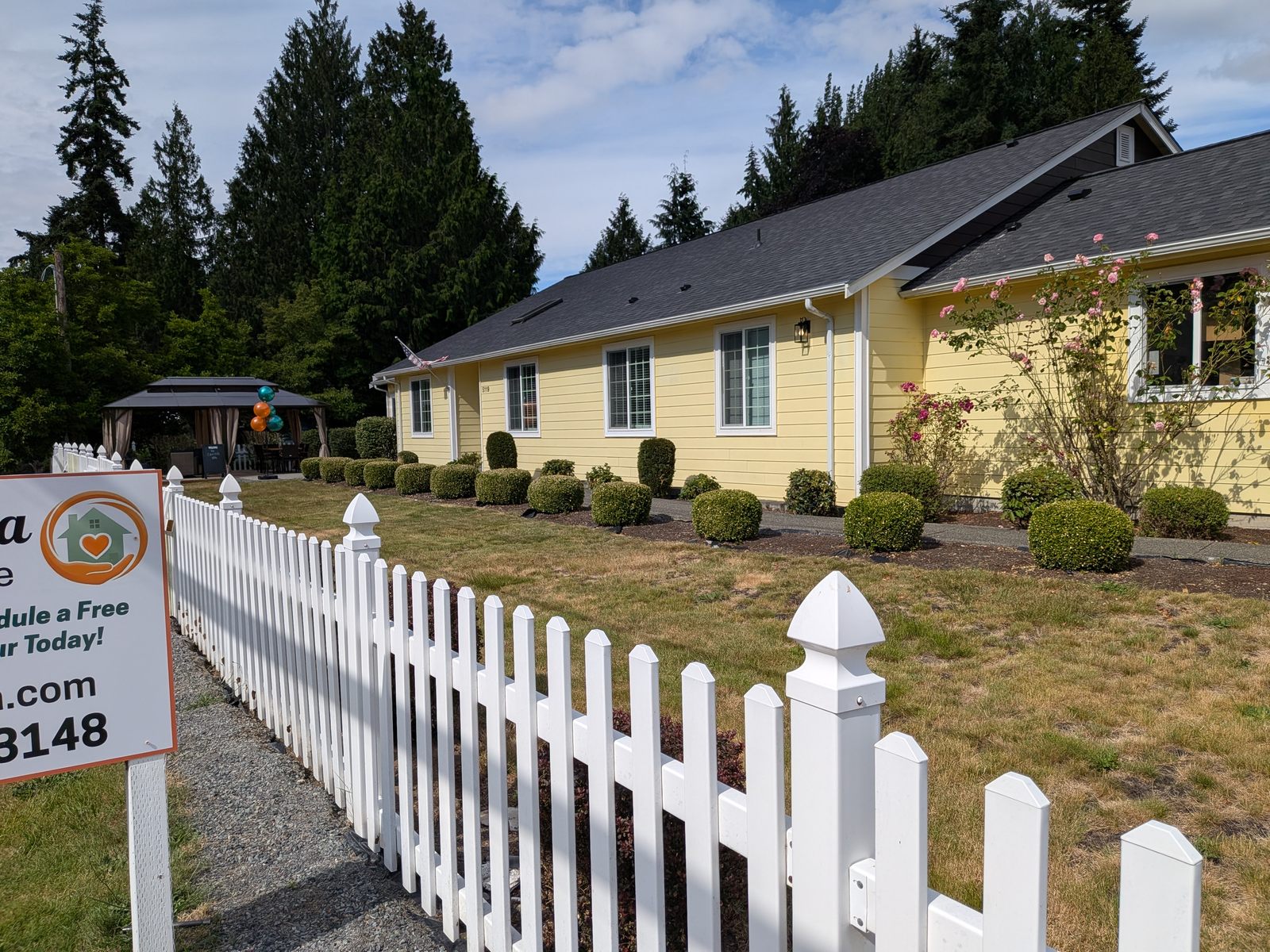
An adult family home is a licensed residential care home in a single-family house setting where up to six adults receive personalized daily care, meals, supervision, and medical support. It sits between assisted living and skilled nursing: smaller, warmer, and more personal than a facility, yet capable of far more clinical care than standard assisted living. In Washington State, adult family homes are licensed by DSHS under RCW 70.128. Because the resident-to-caregiver ratio is low, care is consistent and deeply personalized — a critical advantage for someone with Parkinson's whose needs change week to week. You can read more in our complete guide to adult family homes in Washington State.

When Is It Time for Residential Care?
Families often ask when the "right time" is to transition a loved one with Parkinson's into residential care. There is no single moment — but there are clear signals. The American Parkinson Disease Association recommends planning for future care needs early, while the person with Parkinson's can still participate in decisions. Recurrent falls, medication mismanagement, missed doses that produce severe symptom swings, difficulty eating or swallowing, increasing confusion at night, caregiver exhaustion, and unplanned hospitalizations are all signs that home care has reached its limits.
Consider residential care when you notice any of the following:
- Two or more falls in a year, or any fall requiring medical attention
- Difficulty managing medications on schedule, with missed doses causing symptom swings
- Weight loss or dehydration from swallowing problems
- Wandering or nighttime confusion that puts safety at risk
- A caregiver who is physically or emotionally overwhelmed
- A recent hospitalization that revealed needs the family cannot meet at home
The transition is almost always smoother when it is planned rather than reactive. Touring options before a crisis — while the person with Parkinson's can still communicate preferences — gives the entire family agency in the decision.
Clinical Capabilities to Demand for Advanced Parkinson's
As Parkinson's advances, the clinical demands of daily care intensify. Any residential provider you choose must be able to demonstrate specific capabilities, not merely promise a caring environment. These are the capabilities our high-acuity care services are built around, and the same questions should guide every family's evaluation.
Medication Management and Timing
Parkinson's medications, particularly carbidopa-levodopa, work on tight timing. A dose taken thirty minutes late can mean an hour of rigidity, tremor, or inability to move. Staff must track medication schedules precisely, recognize on/off fluctuations, and communicate changes to the prescribing neurologist. Homes without a registered nurse on staff may struggle with this level of medication oversight.
Fall Prevention and Mobility Support
Postural instability makes falls the leading cause of hospitalization for people with Parkinson's. The home should have grab bars, clear walking paths, fall-alert systems, and staff trained in safe transfer techniques. Caregivers who understand freezing of gait — the sudden inability to take a step — can intervene before a fall happens rather than after.
Swallowing and Nutrition Support
Dysphagia, or difficulty swallowing, affects the vast majority of people with advanced Parkinson's. It raises the risk of choking, aspiration pneumonia, and malnutrition. A residential home should be prepared to adapt food textures, supervise meals, and recognize the early signs of aspiration. Some residents may eventually require feeding tube support, which demands trained nursing oversight.
24-Hour Availability and Monitoring
Advanced Parkinson's does not keep office hours. Nighttime immobility, off-periods, anxiety, and urinary urgency are common. Caregivers should be available around the clock, and the home should have a clear protocol for medical changes and emergencies, including coordination with the resident's care team.
How Edmonds Villa's RN-Led Model Helps
Edmonds Villa is an RN-owned and operated high-acuity adult family home in Edmonds, Washington. That distinction matters for Parkinson's residential care in a way that is hard to overstate. Because a registered nurse both owns and operates the home, clinical decision-making is baked into daily operations rather than layered on top of them. Our RN-led approach to care means a nurse is not a visitor who stops by once a week — nursing judgment guides every shift.
For a resident with Parkinson's, this translates directly into the capabilities families worry about most. Medication timing is managed with nursing precision. Falls and swallowing changes are caught early because caregivers are trained to recognize them. The home communicates directly with neurologists, primary care physicians, and hospice teams. And because the home is limited to six residents, the same caregivers who know a resident's morning routine also recognize the subtle clinical shifts that precede a crisis. Families get the warmth of a real home and the clinical confidence of a nursing setting — without the institutional feel of a large facility.
Not sure which level of care fits your loved one's stage of Parkinson's? Call us at (425) 400-3184 or request a free consultation — we will help you compare options honestly, even if Edmonds Villa is not the right fit.

How to Evaluate a Parkinson's Residential Care Provider
Touring homes with a checklist turns an emotional search into a methodical one. Beyond the warmth of the space, evaluate the following before committing:
- Licensing: Confirm an active DSHS license using the Residential Care Facility Search tool online.
- Nursing presence: Ask directly whether a registered nurse is on staff or oversees care, and how often.
- Medication protocol: Ask how medication timing is tracked and what happens if a dose is missed.
- Fall history: Ask about recent falls and how the home documents and responds to them.
- Staffing ratios: A lower resident-to-caregiver ratio means more attention per resident.
- Swallowing and feeding: Ask how the home handles modified diets, thickened liquids, and feeding tubes.
- Medical coordination: Ask how the home communicates with the resident's neurologist and primary care physician.
- Visitation and family involvement: Confirm family members are welcome to visit at any time.
Take the person with Parkinson's on the tour if possible. Observe how staff interact with residents, how quickly call bells are answered, and whether residents appear engaged and comfortable. Trust the responses to your questions — homes with strong clinical programs answer without hesitation.
Cost of Parkinson's Residential Care
The cost of Parkinson's residential care in Washington State varies widely by setting. Assisted living typically ranges from $5,000 to $8,000 per month; memory care costs more, often $6,500 to $10,000 per month; and skilled nursing averages around $12,000 per month. Adult family homes generally range from $4,500 to $9,000 per month, with RN-supervised high-acuity homes at the higher end of that range.
Payment options matter as much as the monthly figure. Long-term care insurance, VA Aid and Attendance benefits for veterans, and Washington's COPES Medicaid waiver can offset significant portions of the cost. Families should ask each provider which payment types they accept and what is included in the monthly rate — room, board, medication management, and skilled nursing oversight are not always bundled the same way.
Frequently Asked Questions
What is Parkinson's residential care?
Parkinson's residential care is a living arrangement in which a person with Parkinson's disease receives 24-hour support, supervision, and medical oversight outside their own home. Options range from memory care units and assisted living to skilled nursing facilities and licensed adult family homes like Edmonds Villa.
What types of residential care are available for someone with Parkinson's?
Families can choose from memory care units, assisted living facilities, skilled nursing facilities, and adult family homes. Each setting differs in size, staffing, and clinical capability. For advanced Parkinson's, an RN-led adult family home like Edmonds Villa offers the warmth of a home with the medical oversight of a nursing setting.
When is it time to move a loved one with Parkinson's into residential care?
Common signals include recurrent falls, missed or mismanaged medications, difficulty swallowing, nighttime confusion, unplanned hospitalizations, and caregiver exhaustion. Planning the transition early — while the person with Parkinson's can still participate in decisions — leads to a smoother move.
What clinical capabilities matter most for advanced Parkinson's residential care?
Look for precise medication management, fall prevention and safe transfer training, swallowing and nutrition support for dysphagia, and 24-hour caregiver availability. A registered nurse on staff or on-site significantly strengthens a home's ability to manage the complex, changing needs of advanced Parkinson's.
Does Medicare or Medicaid cover Parkinson's residential care?
Medicare generally does not pay for long-term residential care, though it covers short-term skilled care and therapies. Washington's COPES Medicaid waiver can help pay for personal care services, and the Community First Choice (CFC) program offers additional coverage for eligible residents.
What makes Edmonds Villa's RN-led model different for Parkinson's care?
Edmonds Villa is RN-owned and operated, so nursing judgment is part of everyday care. Residents benefit from precise medication timing, early detection of falls and swallowing risks, direct coordination with neurologists, and consistent caregivers who know them personally — in a six-resident home rather than a large facility.
Choosing Parkinson's residential care is one of the most consequential decisions a family will make — but it does not have to be made from a place of panic. Understand the full landscape: memory care, assisted living, skilled nursing, and adult family homes. Then measure each option against the clinical realities of Parkinson's, not just the aesthetics of the space. When the disease advances, the strongest option is often the one that pairs a real home with genuine nursing capability.
At Edmonds Villa, residents with Parkinson's and their families find exactly that combination. We invite you to schedule a tour, meet our team, and see for yourself how an RN-led adult family home supports the people behind the diagnosis.