When families start comparing long-term care, one question comes up over and over: what is the real difference between an adult family home and an assisted living facility? On the surface, both promise the same thing — help with daily life for an older adult who can no longer manage entirely on their own. But behind that shared promise, the two models differ in almost everything that shapes a resident's day: the building they live in, the people caring for them, the rules that govern the setting, the level of hands-on care, and the monthly cost. Choosing between them without understanding those differences is how families end up with a placement that feels wrong from week one.
This guide breaks down the real difference between an adult family home and an assisted living facility in plain language, with the specifics that matter in Washington State. You'll learn what each setting actually looks like, how staffing and regulation compare, when a small residential care home can rival skilled nursing, and how to decide which model fits your loved one's needs — and your family's budget.
What an Adult Family Home Actually Is
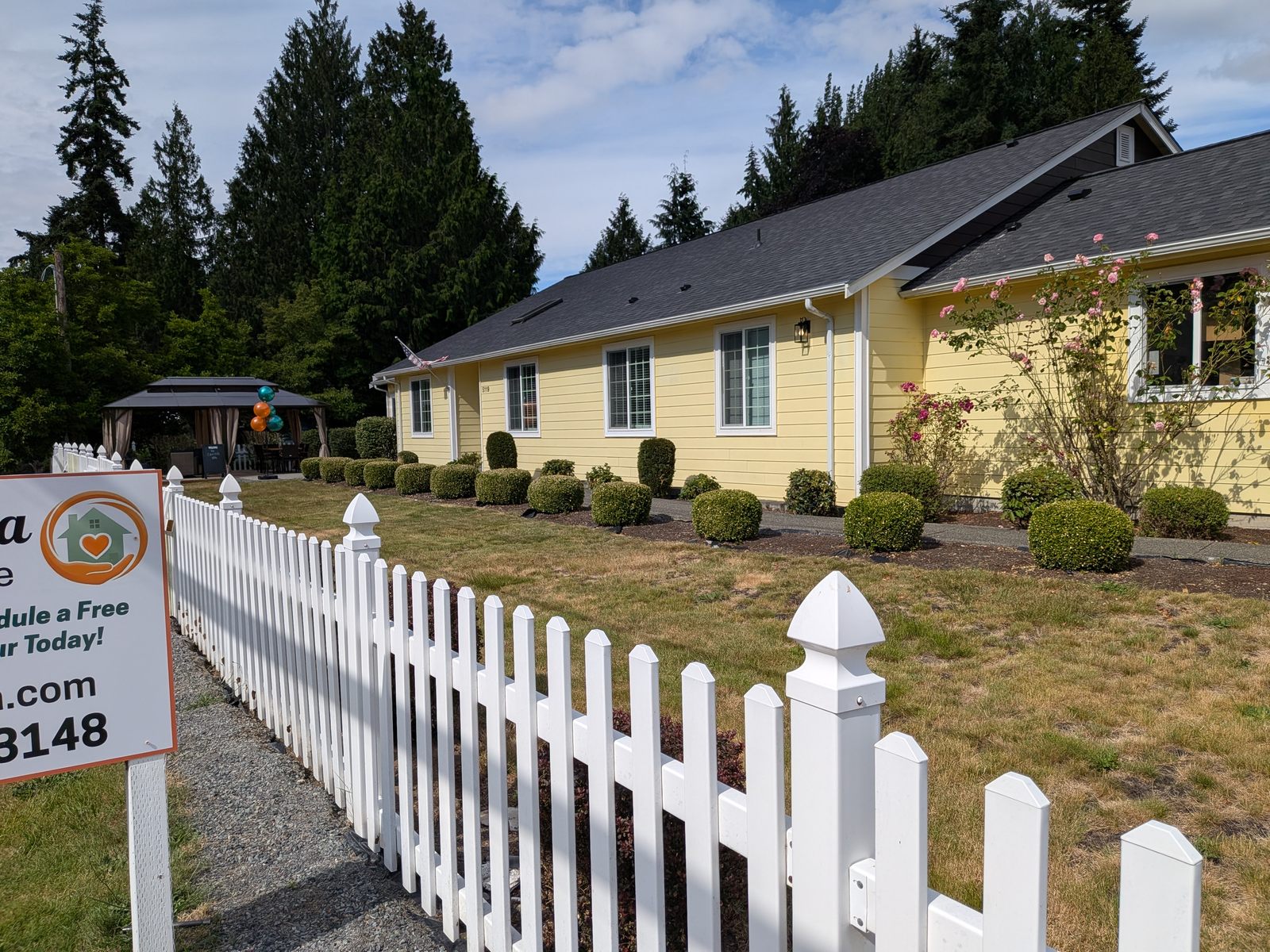
An adult family home (AFH) is a licensed residential care home in a single-family house where up to six residents receive personal care, meals, supervision, and medical support. It is regulated in Washington State by DSHS under RCW 70.128. Caregivers are present around the clock, and in many homes — including Edmonds Villa — the owner is actively involved in daily care rather than supervising from an office. For a deeper walkthrough of this model, see our complete guide to what an adult family home is in Washington State.
The setting matters more than people expect. Residents live in an actual house with a shared kitchen, a living room, a backyard, and a front door that opens onto a quiet street. Meals are cooked in the same kitchen where the caregiver works. There is no reception desk, no activity calendar laminated on a hallway wall, no call button mounted beside a door labeled with a wing number. The scale is small enough that a caregiver who knows your mother's coffee order is the same person who helps her shower in the morning.
What adult family homes provide includes:
- Assistance with bathing, dressing, grooming, and toileting
- Meal planning, cooking, and dietary support
- Medication management and nursing task delegation
- Supervision for residents with dementia, wandering risk, or fall risk
- Housekeeping, laundry, and personal errands
- Coordination with physicians, hospice, and therapy providers
What Assisted Living Actually Is
An assisted living facility (ALF) is a much larger, apartment-style community — typically 40 to 200+ residents — where each resident has their own apartment or studio. The model emphasizes independence: private units, communal dining rooms, activity programs, transportation, and scheduled assistance with daily tasks. In Washington State, assisted living is licensed under a separate set of rules (RCW 18.20) administered by the same DSHS agency that oversees adult family homes. The National Institute on Aging describes these communities in detail — apartments with services layered on top.
Think of assisted living as a community with services layered on top. There is a front desk, a dining room with scheduled meal times, an activities director, and staff organized into departments — medication aides, dining staff, housekeeping, nursing. That structure brings real benefits: a built-in social scene, more amenities, and a lifestyle that can feel closer to independent apartment living. But it also means care is delivered on a schedule by rotating staff, and the ratio of hands-on attention per resident is fundamentally different from a six-resident home.
Not sure which model fits your family? Talk through your loved one's needs with an RN who runs a care home every day — no obligation.
Talk With a Care TeamThe Real Differences, Side by Side
Here is the real difference between an adult family home and an assisted living facility in the categories that actually shape quality of life.
Size and Setting
An adult family home holds a maximum of six residents in a single-family house. An assisted living facility holds dozens to hundreds of residents in a multi-story or campus-style building. The practical effect: in an AFH, a resident is the familiar face in a household; in an ALF, a resident is one of hundreds.
Staffing and Consistency
In an adult family home, the same small caregiving team works with the same residents every day. Caregivers learn each person's history, preferences, and early warning signs of decline. In assisted living, staff rotate across shifts, departments, and buildings, so the person who answers a call light at 2 a.m. may never have met the resident before. For residents with dementia, that consistency is not a comfort feature — it is clinical care.
Regulation and Oversight
Both settings are licensed by Washington DSHS, but under different statutes. Adult family homes operate under RCW 70.128; assisted living facilities operate under RCW 18.20. You can verify the active license of either setting using the DSHS Residential Care Facility Search tool before you ever schedule a tour.
Cost and Payment
For a comparable level of care, adult family homes are often similar to or less expensive than assisted living — a reflection of their smaller scale and fewer administrative layers. Private pay is the most common arrangement in both models. In Washington, adult family homes are also frequently covered through the COPES Medicaid waiver and the Community First Choice program, which makes them an accessible option for families with limited assets. Whatever the model, the specifics depend on the level of care, room type, and location.

When a Small Home Rivals Skilled Nursing
Most families assume that bigger means more capable — that the large facility is the only place equipped for complex medical needs. That assumption is outdated. A growing number of adult family homes have been designed specifically to care for residents with high-acuity needs: conditions that once sent people to skilled nursing or a hospital.
Edmonds Villa is an example of how far this model can go. It is RN-owned and operated, meaning a registered nurse is not a visiting consultant but the person in charge of daily clinical care. Our high-acuity care services include complex medication management, tube feeding, dialysis support, tracheostomy care, Parkinson's management, bariatric care, and oversight of chronic neurological conditions. For a resident with needs at this level, a carefully managed six-resident home can deliver more consistent, more attentive care than a facility where a nurse manages a caseload across multiple floors.
The reason is structural. In a small high-acuity home, the clinical protocols, the caregiver training, and the RN supervision are built around six people. Every caregiver knows every diagnosis. Every shift has direct access to the owner-operator. That density of expertise, applied to a tiny resident census, is why many families leave skilled nursing and move a loved one into a well-run adult family home — not the other way around.
Which Model Fits When
The honest answer to "which is better?" is that it depends entirely on the resident. The models solve different problems.
Choose an adult family home when your loved one needs:
- Hands-on daily assistance with most activities of daily living
- A calm, low-stimulation environment — common with dementia
- Caregivers who know them personally and notice changes early
- Clinical oversight for complex or unstable medical conditions
- A homelike setting that feels like an extension of family care
Choose assisted living when your loved one needs:
- Independence with a private apartment and light support
- A built-in social calendar, group activities, and larger dining
- Lifestyle amenities like fitness classes and scheduled outings
- Care that is mostly scheduled rather than continuous
If the resident is still largely independent and would thrive in a community, assisted living is a reasonable fit. If the resident needs consistent, close support and would feel lost in a crowd, an adult family home is usually the better match — and for medically complex residents, often the only realistic one short of skilled nursing.

How to Choose Confidently
Choosing between an adult family home and assisted living is a high-stakes decision, but it doesn't have to be an agonizing one. A structured approach removes most of the guesswork.
- Start with a functional assessment, not a brochure. Write down what your loved one can and cannot do — bathing, dressing, medication, transfers, toileting, wandering. That list, not the amenities, determines the right model.
- Verify licensing. Look up the active DSHS license for any home or facility on your shortlist. A provider who cannot produce a current license number is not legally allowed to provide personal care to unrelated adults.
- Ask about staffing ratios and consistency. In assisted living, ask how many residents each caregiver covers and how often staff rotate. In an adult family home, ask who is present at night and how long the care team has been together.
- Tour at different times of day. See the morning routine, the lunch service, and the evening transition — not just the midday lull that tours are scheduled around.
- Match the clinical capability to the condition. If your loved one has complex needs, confirm the setting can actually deliver the required care — which is where our RN-led care approach differs from the standard model.
- Talk through finances with a clear-eyed budget. Compare the full monthly cost, what is included, and whether the setting participates in the COPES waiver or other payer programs.
If you would like to see what high-quality residential care looks like in practice, schedule a tour of Edmonds Villa. You'll see the difference between a facility and a home long before you sit down to compare numbers.
Frequently Asked Questions
What is the real difference between an adult family home and an assisted living facility?
The real difference is scale, setting, and staffing. An adult family home is a licensed single-family house caring for up to six residents with consistent caregivers who know each person's routine, while an assisted living facility is an apartment-style building housing 40 to 200+ residents with rotating staff. Adult family homes are regulated by DSHS under RCW 70.128 and generally provide more hands-on daily care in a homelike setting.
Is an adult family home the same as assisted living?
No. They are two distinct licensed care models in Washington State. Assisted living facilities are larger, apartment-based communities regulated under a separate set of rules, while adult family homes are small residential care homes capped at six residents. The staffing model, regulatory oversight, cost structure, and level of individualized care all differ.
Which is less expensive — an adult family home or assisted living?
For a given level of care, adult family homes are often comparable to or less expensive than assisted living because they operate at a smaller scale with fewer administrative layers. Costs vary by room type and care needs, but many families find the one-on-one attention per dollar is higher in a small residential care home. Both accept private pay, and adult family homes may also be covered through Washington's COPES Medicaid waiver.
Can an adult family home care for someone with high medical needs?
Yes — and this is where the difference matters most. Standard adult family homes can support residents with dementia, mobility challenges, and daily nursing tasks. High-acuity adult family homes like Edmonds Villa go further, providing RN-owned and operated care for residents who might otherwise need skilled nursing, including complex medication management, tube feeding, and chronic condition oversight.
How are adult family homes regulated in Washington State?
Adult family homes are licensed and monitored by the Washington State Department of Social and Health Services (DSHS) under RCW 70.128. Homes are subject to regular inspections, and license status can be verified using the DSHS Residential Care Facility Search tool. Assisted living facilities are regulated under separate statutes.
How do I decide between an adult family home and assisted living for my parent?
Start with the level of care needed, not the building. If your loved one needs consistent, hands-on daily support and would feel lost in a large community, an adult family home is often the better fit. If they prize independence, an active social calendar, and an apartment-style lifestyle with less hands-on care, assisted living may suit them better. Tour both and ask about staffing ratios and caregiver consistency.
The Takeaway
The real difference between an adult family home and an assisted living facility is not a matter of which is "better." It's a matter of which model matches the life your loved one actually lives — their needs, their medical complexity, their personality, and the kind of attention that will keep them safe and well. An adult family home trades the amenities and social scale of a large community for something harder to measure: a small group of people who know each other, in a real house, with caregivers who show up for the same six residents every day. For the right resident — especially one with complex needs — that trade is the whole point.
If you are weighing these options now, you don't have to do it alone. Call (425) 400-3184 or contact Edmonds Villa to talk through your loved one's situation with an RN who has built a career on this exact question.