Neurological Disorders
Near Mountlake Terrace
Edmonds Villa provides specialized neurological disorders for families from Mountlake Terrace and surrounding communities. Our Edmonds location offers expert care in a comfortable, homelike environment.
Parkinson's Disease, and the Home That Can Care for It in Mountlake Terrace
Sandra, RN, owner and operator of Edmonds Villa, on what Parkinson's disease actually is, and what a home has to do to care for someone living with it.
Specialized Care for
Mountlake Terrace Families
Finding quality neurological disorders near Mountlake Terrace can be challenging. Many care facilities lack the specialized equipment, trained staff, or experience to serve high-acuity patients effectively. Edmonds Villa fills this gap with dedicated neurological disorders services in our 6-bed adult family home.
Located in Edmonds, we serve families from Mountlake Terrace and throughout South Snohomish County and North King County. Our specialized focus means your loved one receives expert care from staff who understand their specific needs.
Neurological conditions like Parkinson's disease, ALS, MS, and traumatic brain injuries present unique care challenges. The National Institute of Neurological Disorders and Stroke emphasizes the importance of specialized, coordinated care for these complex conditions.
Discuss Your Needs →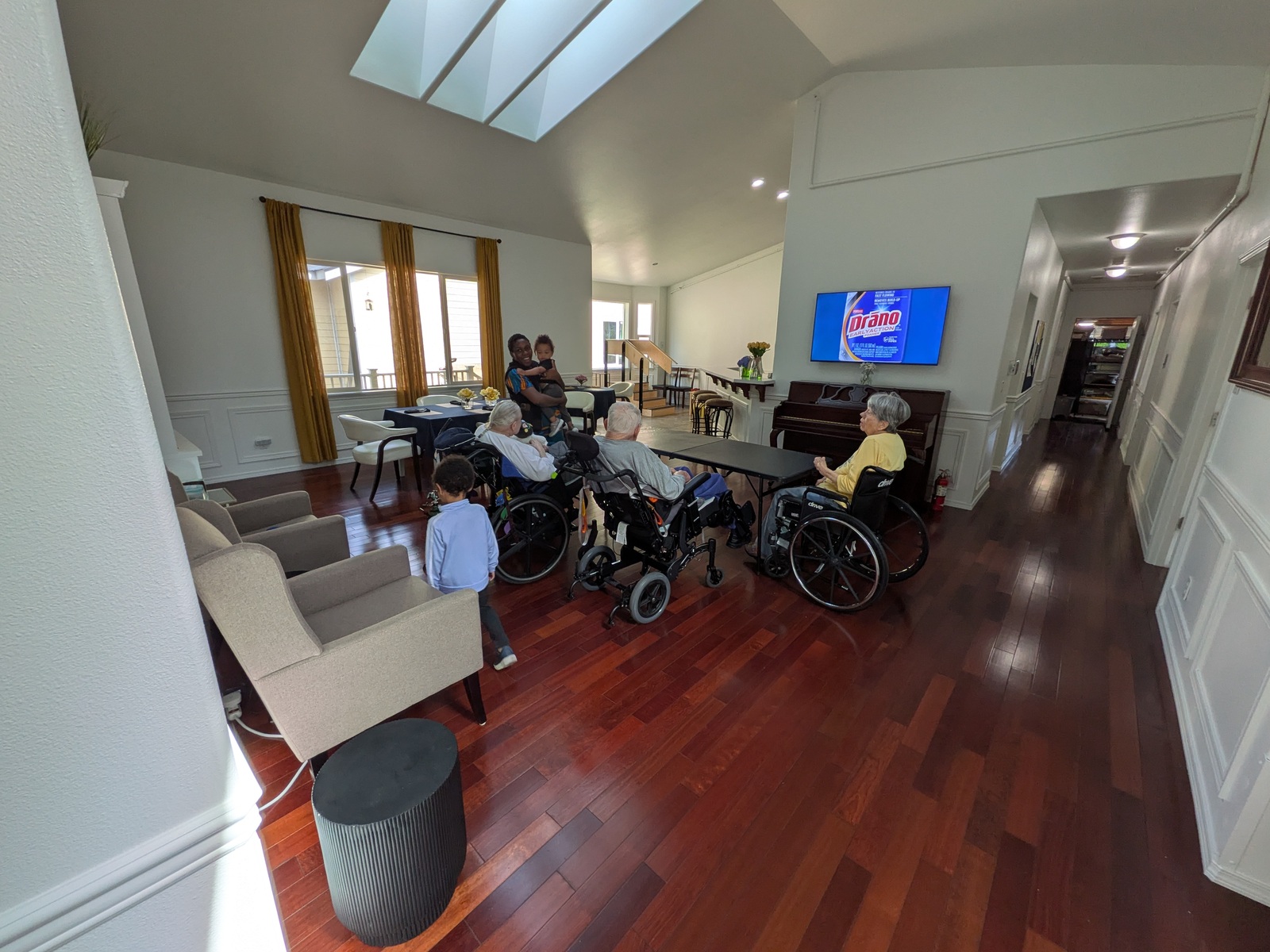
Home Setting
Why Mountlake Terrace Families Choose Edmonds Villa
The National Institute on Aging recommends evaluating care quality alongside location when choosing facilities
Specialized Expertise
Trained staff with specific expertise in neurological disorders that many facilities cannot provide.
Personalized Attention
With just 6 beds, your loved one receives individualized care from consistent caregivers.
Nursing Oversight
Licensed nurses provide medical supervision, medication management, and physician coordination.
Home Environment
A real home with home-cooked meals, comfortable spaces, and dignified living—not an institution.
Convenient Location
Easy access from Mountlake Terrace makes regular family visits convenient.
24/7 Care
Round-the-clock care and supervision with prompt response to any needs or concerns.
Additional Services for Mountlake Terrace Families
In addition to neurological disorders, Edmonds Villa provides comprehensive high-acuity care
Many residents have multiple care needs. Our integrated approach addresses all conditions while preventing conflicts between treatments. We also serve Mountlake Terrace families with:
- Bariatric Care - Specialized equipment and dignified care for patients with obesity
- Dialysis Support - PD and HHD support with trained staff
- Enteral Feeding - J-tube and G-tube management
- Neurological Care - Parkinson's, ALS, MS, and TBI support
- Heart & Lung Care - Cardiovascular and pulmonary management
- Complex Metabolic Care - Diabetes, arthritis, and bedridden care
- Oncology and Cancer Management - Specialized cancer care and management
According to Washington State DSHS, adult family homes provide residential care in a home setting. Edmonds Villa takes this further with specialized high-acuity capabilities.
Neurological Care for Mountlake Terrace Families
Neurological conditions reward routine and punish disruption. In Parkinson's disease, a dose that lands an hour late can stiffen a body that was moving comfortably an hour before. After a traumatic brain injury, an unfamiliar room can undo weeks of calm. Progression in ALS or multiple sclerosis arrives in steps, not a slope, and each step rearranges what daily care has to cover.
Edmonds Villa is a licensed six-bed adult family home in Edmonds, and Mountlake Terrace Station on the 1 Line puts it within reach of family members who do not drive. A daughter can ride the train from Mountlake Terrace, spend an afternoon, and be home for the evening without borrowing a car.
Medication Timing in Parkinson's Disease
Levodopa works on a schedule, and that schedule is close to sacred. Doses are given at the times prescribed, not clustered around staff convenience, and we track how well the medication is holding between doses. When a resident narrows or widens, when dyskinesia appears, or when a dose wears off early, that pattern is written down and shared with the neurologist.
Protein timing matters for some residents, since a heavy meal can compete with the drug's absorption. Because our meals are cooked in the house, timing can be adjusted to the resident rather than the resident to the kitchen.
ALS and MS: Adapting as Ability Changes
In ALS the goal is to keep function where it is and prepare for what comes next. We watch speech, swallowing, and hand strength, introduce equipment before it is strictly needed, and coordinate with therapy teams so a change in breathing or in mobility is met with a plan instead of a scramble. In MS, energy is the scarce resource, and heat, infection, and fatigue can all trigger a flare that looks like permanent decline.
Equipment decisions are made early here, while there is still time to think them through. A power chair ordered before it is strictly necessary gives a resident months of independent movement instead of a rushed transition, and a communication device introduced while speech is still usable is far easier to learn than one handed over in a crisis. We would rather plan a step ahead than catch up to one.
Seizure Precautions and Brain Injury
For residents with a seizure history, we keep the environment low to the floor where it matters, pad what can be padded, and record every event with its time, duration, and what the body did. Staff do not restrain a seizure or put anything in the mouth. Rescue medication is kept where it is needed and checked for expiry.
After a TBI, behavior can be the hardest part of care. Short, quiet instructions, a predictable daily rhythm, and one thing at a time work far better than reasoning with someone whose reasoning has been injured. The Parkinson's Foundation and the Alzheimer's Association both offer family-facing guidance on communication that we build into daily routines.
Swallowing, Contractures, and Cognition
Dysphagia is monitored at every meal. We follow texture and liquid recommendations, seat residents upright, and watch for coughing, a wet voice, or a fever that suggests something went down the wrong way. When swallowing becomes unsafe, the conversation about a feeding tube happens with the family and the medical team, not around them.
Contracture prevention is unglamorous and constant: range-of-motion work, careful positioning with pillows and wedges, and splints worn as ordered. For residents with cognitive change, we keep the day structured and the surroundings familiar, because orientation is easier to maintain than to rebuild.
Neurological Disorders FAQs
Does Edmonds Villa provide neurological disorders for Mountlake Terrace residents?
Yes. Edmonds Villa serves families from Mountlake Terrace and throughout the region with specialized neurological disorders. Our Edmonds location is conveniently accessible from Mountlake Terrace.
How far is Edmonds Villa from Mountlake Terrace?
Edmonds Villa is located in Edmonds, WA, just a short drive from Mountlake Terrace. Our central location makes it easy for Mountlake Terrace families to visit regularly.
What makes Edmonds Villa's neurological disorders different?
Our 6-bed adult family home provides personalized attention that larger facilities cannot match. Residents receive consistent care from staff who know them well, with specialized training in neurological disorders.
Can Mountlake Terrace families tour Edmonds Villa?
Absolutely. We welcome families from Mountlake Terrace to tour our facility, meet our caregivers, and learn about our neurological disorders services. Call (425) 400-3184 to schedule.
Does Edmonds Villa accept Medicaid for neurological disorders?
We work with various payment options including private pay and some Medicaid programs. Contact us to discuss your specific situation and financial options for neurological disorders.
Schedule a Tour
Mountlake Terrace families are welcome to visit Edmonds Villa. See our facility and learn how we can provide neurological disorders for your loved one.