When a family first starts searching for residential care for a parent or spouse, the questions that keep them up at night are rarely about paperwork. They're about worry: Can Dad still be safely left alone at night? Who will make sure Mom's Parkinson's medication is given on time? What happens if there's a medical emergency at 3 a.m.? The word "licensed" is reassuring, but for most families it's also vague — a stamp on a website, not something they understand well enough to trust or to question.
Understanding what it means to be a licensed care home in Washington State is one of the most practical things a family can do before choosing a home. Licensing isn't a marketing badge. It's a legal status granted and enforced by the state's Department of Social and Health Services (DSHS) under a specific law, RCW 70.128, and it carries real obligations: background checks, required training, liability insurance, annual fees, and unannounced inspections. When you understand that framework, you can tell the difference between a home with genuine accountability behind its promises and an arrangement that merely looks like care.
At Edmonds Villa, a DSHS-licensed, RN-owned high-acuity adult family home in Edmonds, Washington, that distinction is the foundation of how we operate. This guide walks through exactly what Washington State requires of a licensed care home, what the state actually verifies, and how you can confirm any home's license yourself before you make a decision that affects someone you love.
What It Means to Be a Licensed Care Home in Washington State
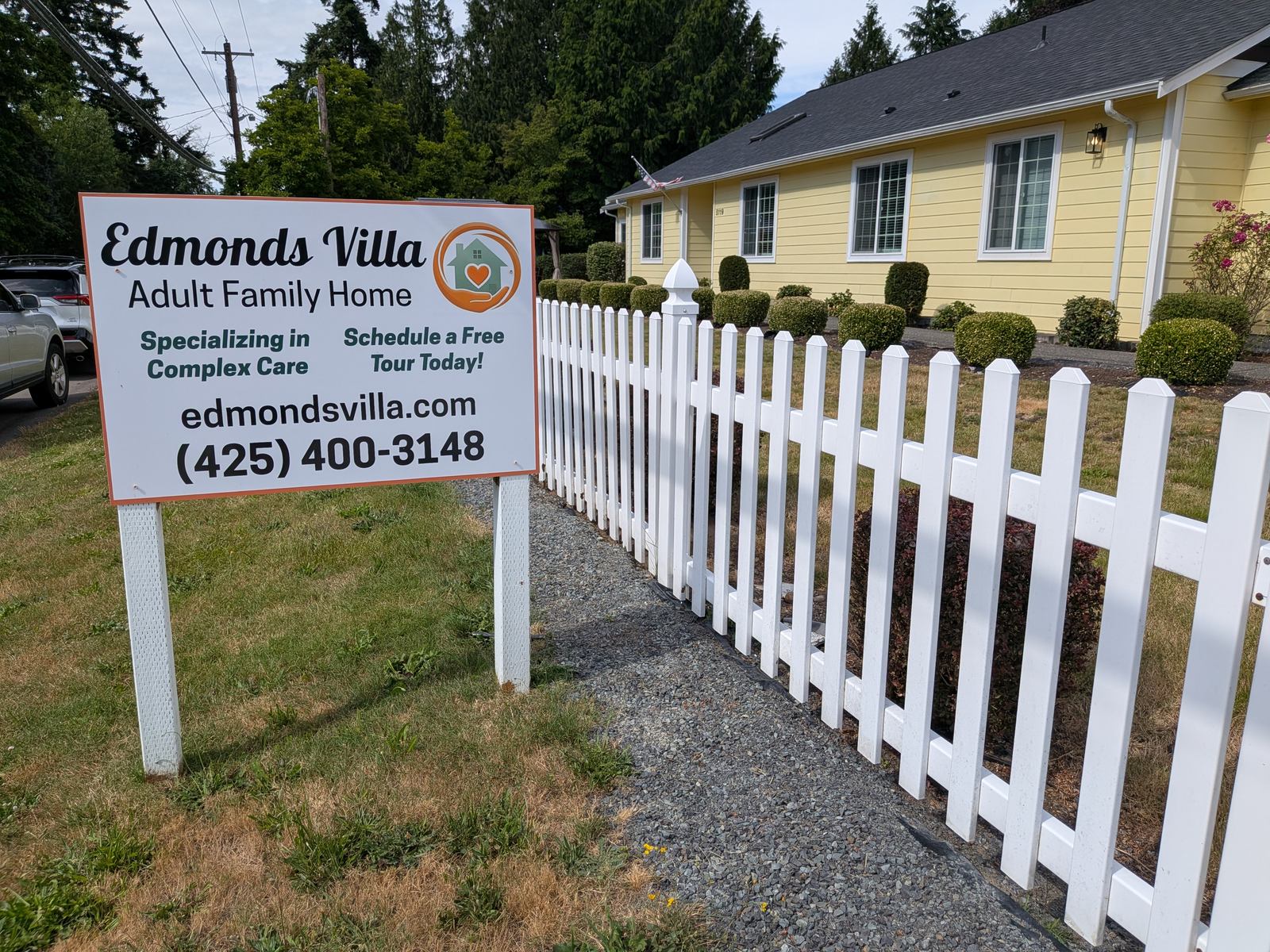
In Washington State, the legal name for a licensed residential care home of up to six residents is an adult family home (AFH). The word "licensed" means the state has formally authorized a specific operator and a specific house to provide personal care services — help with bathing, dressing, meals, medication, and supervision — to unrelated adults. That authorization is not automatic, and it is not permanent. It has to be earned through training and background checks, paid for and renewed each year, and maintained by passing unannounced state inspections.
A license is also tied to a particular person and a particular place. If the operator changes or the home moves, the license must be reassessed. That means when a home holds up a current DSHS license number, it is making a specific, verifiable claim: a licensed caregiver is in charge, the house has been inspected and found safe, and the state can and will come back to check again. That is the accountability families are really looking for — not a promise of good care, but proof that the home answers to someone with the power to act.
If you're just beginning to research the model itself, our guide to what an adult family home is explains how these homes are structured, who they serve, and how they fit into the broader care continuum. Here, we're focused on the licensing itself: what the law demands, what it verifies, and why it matters.
The Legal Foundation: DSHS and RCW 70.128
Washington's adult family home law lives in RCW 70.128, the chapter of state code titled "Adult Family Homes." It defines what an AFH is, who may operate one, what services may be provided, and what the state may do when a home falls short. Oversight sits with the Department of Social and Health Services, through its Residential Care Services division, which issues the license, sets the operating rules, and conducts the inspections that keep licenses honest.
The obligations placed on a licensed provider are concrete. A home must carry liability insurance, maintain current records of resident care plans and medication administration, keep the building in compliance with safety and accessibility standards, and pay the state's licensing fee on time. As of July 2025, that fee is $450 per bed, doubled from the previous $225 rate per the DSHS fee schedule. For a typical six-resident home, that is $2,700 per year in licensing fees alone, before insurance, training, and inspection-related costs. Providers who fall behind on the fee face a stop-placement order, which freezes new admissions until the account is current.
None of this is optional, and none of it is decorative. The fee funds the regulatory system that inspects homes. The records requirement is what lets an inspector reconstruct what actually happened on any given shift. The insurance requirement is what gives families a recourse when care falls short. Taken together, these obligations are what convert the word "licensed" from a claim into a system.
What Licensing Requires of Caregivers and Administrators
The people providing the care are where licensing becomes real. Every caregiver in a licensed Washington AFH must complete 75 hours of basic long-term care training, pass the Home Care Aide certification exam, and clear state and federal background checks. Before a home can accept its first resident, the administrator must also complete a 48-hour AFH Administrator course covering the legal and operational responsibilities of running a licensed home. These are not best-practice suggestions; they are conditions of holding a license.
Background checks matter for an obvious reason: the people caring for your loved one are entering their home, handling their medication, and supporting their most intimate daily needs. The training requirements matter for a subtler one. Recognizing when a resident's condition is changing, administering medication correctly, and knowing how to respond when something goes wrong are skills that have to be learned and demonstrated — not intuited on the job.
At the higher end of the spectrum, the bar rises further. High-acuity homes like Edmonds Villa are owned and operated by an RN, which brings licensed nursing judgment into daily decision-making. Complex care such as Parkinson's disease management, dialysis support, and tube feeding depends on precise medication timing, clinical protocols, and nurse delegation that standard caregiver training alone does not cover. When you compare homes, ask not only whether caregivers are certified, but what level of nursing supervision sits behind the care plan.
The Six-Resident Capacity Rule and What It Protects
Washington limits a licensed adult family home to six residents — a number that is not arbitrary. It is the scale at which a single care team can genuinely know every resident: their medication schedules, their mobility needs, their preferences, their personality. A small number of homes hold an enhanced license permitting up to eight residents, but the requirements are intentionally strict — years of clean operation, a residential sprinkler system, and documented financial stability. As of late 2024, fewer than 200 of Washington's roughly 5,000 licensed homes held a seven- or eight-bed license.
For families, the six-resident rule is a quality signal as much as a capacity limit. It is the reason a licensed AFH can provide the kind of attentive, individualized care that larger assisted living buildings cannot replicate, and it is why the state ties the license to the size of the home. A home licensed for six that is actually caring for six is operating within the structure the state inspected.
What Licensing Inspections Actually Verify
A license is only as meaningful as the enforcement behind it. DSHS conducts routine inspections of licensed adult family homes approximately every 15 months, and they are unannounced — the state shows up without warning to see how the home actually operates on an ordinary day. Inspectors review resident care plans, medication records, staffing documentation, emergency preparedness, building safety, and how the home protects resident dignity.
When problems are found, the state has real tools: deficiency citations, required corrective action plans, fines, and — in serious cases — license suspension or revocation. Homes that receive three consecutive clean inspections may qualify for an extended 24-month inspection cycle, which is itself a useful signal: a home on the longer cycle has demonstrated a sustained record of compliance.
This is why inspection history is public. The DSHS Residential Care Facility Search tool lets any family look up a home by name or license number and review its licensing status and inspection findings. Before you tour a home, pull up its record and read the last two inspection reports. A pattern of repeated deficiencies that were never fully corrected tells you more about the home's culture of accountability than any guided tour will.
Licensed Care Home vs. Unlicensed Boarding and Rental Arrangements
Licensing matters because the alternative exists. Across Washington, families can encounter arrangements that look like care homes but are not licensed: a private house where someone rents a room and the homeowner "helps out," a boarding arrangement advertised as a care home without a DSHS license, or a situation that deliberately avoids the word "care" in order to stay outside the law.
The legal line is straightforward. Under RCW 70.128, providing personal care services to unrelated adults in a residential setting requires a license. An unlicensed home can rent a room — but it cannot legally help with bathing, medication, or the daily hands-on tasks that make a care home a care home. When an arrangement crosses that line without a license, it is operating illegally, and everything that licensing provides — trained staff, inspected premises, state oversight, and recourse when something goes wrong — is simply absent.
Red flags to take seriously: a home that cannot produce a current DSHS license number when asked; an operator who says they're "just helping out" rather than providing care; requests for payment in cash only; no written care plan; and staff with no credentials to explain. If any of these describe an arrangement you're considering, it is not a licensed care home, and it is not a safe place for a loved one with care needs. When in doubt, run the name and address through the DSHS search tool before you commit to anything.
Why Choosing a Licensed Care Home Matters for Your Family
Choosing a licensed home is, at bottom, a decision about accountability. A licensed provider is answerable to the state in a way an unlicensed operator is not. Its staff are trained and screened. Its premises are inspected. Its records are subject to review. And if something goes wrong, there is a regulatory agency that can act — investigate, require changes, fine, or revoke the license. That safety net is the difference between hoping for good care and being able to verify it.
For a practical way to evaluate any home you visit, our adult family home checklist for families turns everything into a room-by-room, question-by-question guide you can take on tour. Bring it, and ask for the license first.
Edmonds Villa's license is not an abstraction. It is issued to Sandra Namwase, RN, the owner and operator, under DSHS license #758617, for a home of up to six residents at 5119 144th St SW, Edmonds, WA. The RN ownership is part of what allows us to provide high-acuity care — neurological conditions, dialysis, tube feeding, bariatric care, and oncology support — in a residential setting, with licensed nursing judgment behind every care plan.
Verifying a license is the first step, but it isn't the last. If your loved one has complex medical needs, the next question is whether a home can actually manage them. Contact Edmonds Villa to discuss your situation, or schedule a tour and see the difference licensed, RN-led care makes.
Frequently Asked Questions
What does it mean for a care home to be licensed in Washington State?
A licensed care home in Washington — legally called an adult family home — is approved and regulated by DSHS under RCW 70.128. Licensing means the operator and caregivers have cleared background checks, completed required training, carry liability insurance, and submit to unannounced state inspections. You can confirm any home's license through the public DSHS Residential Care Facility Search tool.
Is every care home in Washington State required to be licensed?
Yes. Under RCW 70.128, any home providing personal care services to unrelated adults must hold a valid DSHS license. Unlicensed boarding homes and informal rental arrangements are not legally permitted to provide hands-on personal care. If a home cannot produce a current DSHS license number, it is not legally operating as a care home.
What training must caregivers in a licensed Washington care home complete?
Every caregiver must complete 75 hours of basic long-term care training, pass the Home Care Aide certification exam, and clear state and federal background checks. The home's administrator must also complete a 48-hour AFH Administrator course before the home can accept residents. High-acuity homes add licensed nursing oversight on top of these requirements.
How much does it cost to license a care home in Washington State?
The DSHS licensing fee is $450 per bed, doubled from $225 effective July 2025 per the DSHS fee schedule. For a typical six-resident home that is $2,700 per year in licensing fees before insurance, training, and inspection-related costs. Providers who fail to pay face a stop-placement order that blocks new admissions.
How often are licensed care homes inspected in Washington?
Routine inspections occur approximately every 15 months and are unannounced — inspectors arrive without warning to see how the home operates on an ordinary day. Homes with three consecutive clean inspections may qualify for an extended 24-month cycle. Inspection findings are public through the DSHS Residential Care Facility Search tool.
How do I verify that a care home in Washington is properly licensed?
Use the DSHS Residential Care Facility Search tool to look up the home by name or license number and confirm the license is active. Then ask to see the license on your tour and read the last two inspection reports. A home that cannot immediately produce a current DSHS license number is not legally permitted to provide personal care.
What is the difference between a licensed care home and an unlicensed boarding house?
A licensed care home is regulated by DSHS and may legally provide hands-on personal care, medication support, and supervision. An unlicensed boarding or rental arrangement provides housing only — and is operating illegally if it offers personal care. Choosing an unlicensed arrangement means giving up trained staff, state inspections, and any regulatory recourse.
Licensing Is the Floor — Not the Ceiling
When you understand what licensing actually means, the search for care changes. You stop evaluating homes on atmosphere alone and start verifying the things that genuinely protect your loved one: a current DSHS license, trained and background-checked staff, clean inspection reports, and an operator who can answer for all of it. Those are the fundamentals of any safe care home in Washington State.
But licensing is the floor, not the ceiling. The question isn't only whether a home is licensed — it's whether that home can meet your loved one's specific medical and personal needs. That is the difference between a home that merely passes inspection and one that provides the right care, day after day. We hope this guide helps you ask better questions, and we're always happy to answer ours.