The search for an adult family home usually begins the same way: a parent who can no longer be safely left alone, a hospital discharge that changes everything, a diagnosis that has outrun what care at home can manage. Suddenly you're touring houses full of unfamiliar furniture, comparing things you've never had to compare, and making one of the biggest decisions of your life under time pressure. You deserve a better system than "trust your gut."
This adult family home checklist is that system. Organized by category — licensing, staffing, medical capability, safety, food and nutrition, daily life, communication, finances, and red flags — it turns an overwhelming decision into a sequence of concrete questions you can work through on every tour. Print it or keep it on your phone. Take notes. Use it to compare homes side by side, and to compare what a home says with what you actually observe. If you're still early in your research, our guide to what an adult family home is explains the model itself, and what it means to be a licensed care home in Washington State covers the regulatory framework this checklist leans on.
How to Use This Checklist
A checklist only helps if you use it the same way every time. Read it through once before your first tour so you know what to listen for, then work through the categories in order and write down the exact answers you get — not a summary, the actual words. Compare your notes across homes rather than against a vague memory of what "felt right."
- Ask the same questions at every home. The point is comparison, and you can't compare apples to oranges.
- Ask for the name of the person answering. It matters later when you follow up, and it tells you who actually runs day-to-day care.
- Observe at least as much as you ask. Watch how caregivers interact with residents, whether the home smells lived-in or masked, and whether the pace feels calm or rushed.
- Bring someone with you. A second set of eyes hears things you'll miss while your heart is doing the listening.
1. Licensing & Compliance: Verify the Home Is Legal First
In Washington State, adult family homes are licensed by DSHS under RCW 70.128, and that license is the single most important fact in your entire search. A home that cannot produce a current, active DSHS license number is not legally permitted to provide personal care to unrelated adults — full stop. Licensing is not a box to tick; it is the foundation everything else sits on.
- ☐ Confirm the home holds a current, active DSHS license and write down the number.
- ☐ Verify it yourself using the DSHS Residential Care Facility Search tool — don't rely on the home's word alone.
- ☐ Read the last two inspection reports and note every deficiency.
- ☐ Check the pattern: one corrected citation is normal; repeated citations on the same issue are not.
- ☐ Ask who the licensed provider and administrator are, and what their clinical background is.
- ☐ Confirm the home's capacity — most licensed homes hold six residents — and ask how full it currently is.
- ☐ Ask about the administrator's 48-hour AFH Administrator course and caregivers' 75-hour basic training, both required by law.
Inspection history is public record for a reason — a home with a pattern of incomplete corrective actions is telling you something important about its culture of accountability. For a deeper look at how DSHS regulates these homes, see what it means to be a licensed care home in Washington State.
2. Staffing & Caregiver Coverage
Staffing is where the small-house model earns its keep. Washington requires a minimum ratio of one caregiver per six residents in an adult family home, but many homes operate at 1:3 or better with live-in caregivers — which means the same familiar people know your loved one's routines, preferences, and medical history intimately. The right questions will tell you whether that's actually happening.
- ☐ Ask for the caregiver-to-resident ratio during the day — the exact number, not a range.
- ☐ Ask for the ratio overnight, and whether a caregiver is awake or asleep on call. What happens at 2 a.m.?
- ☐ Ask how many caregivers are on duty right now, during your tour, and how many residents are in the home.
- ☐ Ask about training: 75 hours of basic long-term care training, Home Care Aide certification, and state and federal background checks.
- ☐ Ask about turnover: how long have the current caregivers worked there? Has the team been stable for a year or more?
- ☐ Ask who is in charge clinically, and whether there is RN ownership or supervision. RN oversight is the difference between basic custodial care and true medical management.
- ☐ Ask how care plans are created and who participates — the resident, the family, and which staff members meet to review them, and how often.
Consistency is a medical feature in this model, not a comfort luxury. A caregiver who has worked with a resident for two years notices subtle changes in appetite or energy that a rotating stranger would miss. When you tour, watch whether caregivers address residents by name — that's evidence the model is working.
3. Medical Capability & Medication Management
This is the category where adult family homes diverge most sharply from one another. A standard home manages personal care and medication assistance; a high-acuity home manages complex medical conditions with trained nursing oversight, specialized equipment, and detailed clinical protocols. Knowing which type you need changes everything about which homes should make your shortlist.
- ☐ Ask who administers medications, how errors are tracked and reported, and what happens if a resident refuses a dose.
- ☐ For time-sensitive conditions like Parkinson's, ask how the home guarantees on-time medication administration — to the minute, if that's what the regimen requires.
- ☐ Ask which high-acuity services the home actually provides: tube feeding (G-tube or J-tube), dialysis support, bariatric care, oncology symptom management, or neurological condition management.
- ☐ Ask how the home coordinates with the resident's own doctors and visiting clinicians — who calls whom, and when.
- ☐ Ask whether the home can support aging in place, or whether it will require a transfer if your loved one's needs increase.
- ☐ Ask how the home documents care — what records do caregivers keep, and can you review them?
At Edmonds Villa, an RN-owned and operated high-acuity adult family home in Edmonds, the six-resident scale is a deliberate clinical choice — medication schedules are tracked precisely, and families get licensed nursing oversight inside a genuine home. For a fuller comparison with larger settings, see adult family homes vs. assisted living.
Does your loved one have complex medical needs? Edmonds Villa specializes in high-acuity care that most adult family homes cannot accommodate. Contact us to discuss whether we're the right fit for your family.
4. Safety, Mobility & Emergency Preparedness
Safety in a residential care home isn't one feature — it's a stack of them: physical layout, equipment, protocols, and backup systems. Walk through each of these on your tour, and specifically imagine your loved one in every room.
- ☐ Ask about fall prevention: bed heights, call bells within reach, non-slip surfaces, and monitoring for residents who are unsteady.
- ☐ Ask about transfer equipment: lifts, adjustable beds, and grab bars in bathrooms and showers.
- ☐ Ask whether the home has backup power for medical equipment — critical if your loved one uses oxygen, a feeding pump, or dialysis equipment.
- ☐ Ask about fire safety: alarms, sprinklers, smoke detectors, and whether staff run and document evacuation drills.
- ☐ For residents with dementia, ask how the home prevents wandering and elopement.
- ☐ Ask what the home does in a medical emergency: who calls 911, who notifies the family, and who goes to the hospital with the resident.
Emergency preparedness is where a home's real thinking shows. Any home can say it has a plan. The homes worth choosing can describe, without hesitating, exactly what they would do for your loved one's specific condition at 3 a.m. If a provider can't describe that scenario, they haven't thought it through — and your loved one deserves a team that has.
5. Food & Nutrition
Meals happen three times a day, every day, so food is one of the highest-frequency parts of your loved one's life. It's also, quietly, a window into how the home operates.
- ☐ Ask who prepares the meals and whether they're cooked in the home rather than delivered or reheated.
- ☐ Ask how the home handles dietary needs: diabetic, low-sodium, renal, gluten-free, texture-modified, or thickened liquids.
- ☐ Ask whether residents can snack between meals and drink fluids throughout the day.
- ☐ Ask about mealtime structure: do residents eat together family-style, and is someone available to help those who need assistance feeding themselves?
- ☐ If your loved one needs tube feeding, ask who manages the formula, the pump, and the feeding schedule.
- ☐ Ask whether the home respects food preferences and accommodates cultural or religious dietary practices.
6. Activities & Daily Life
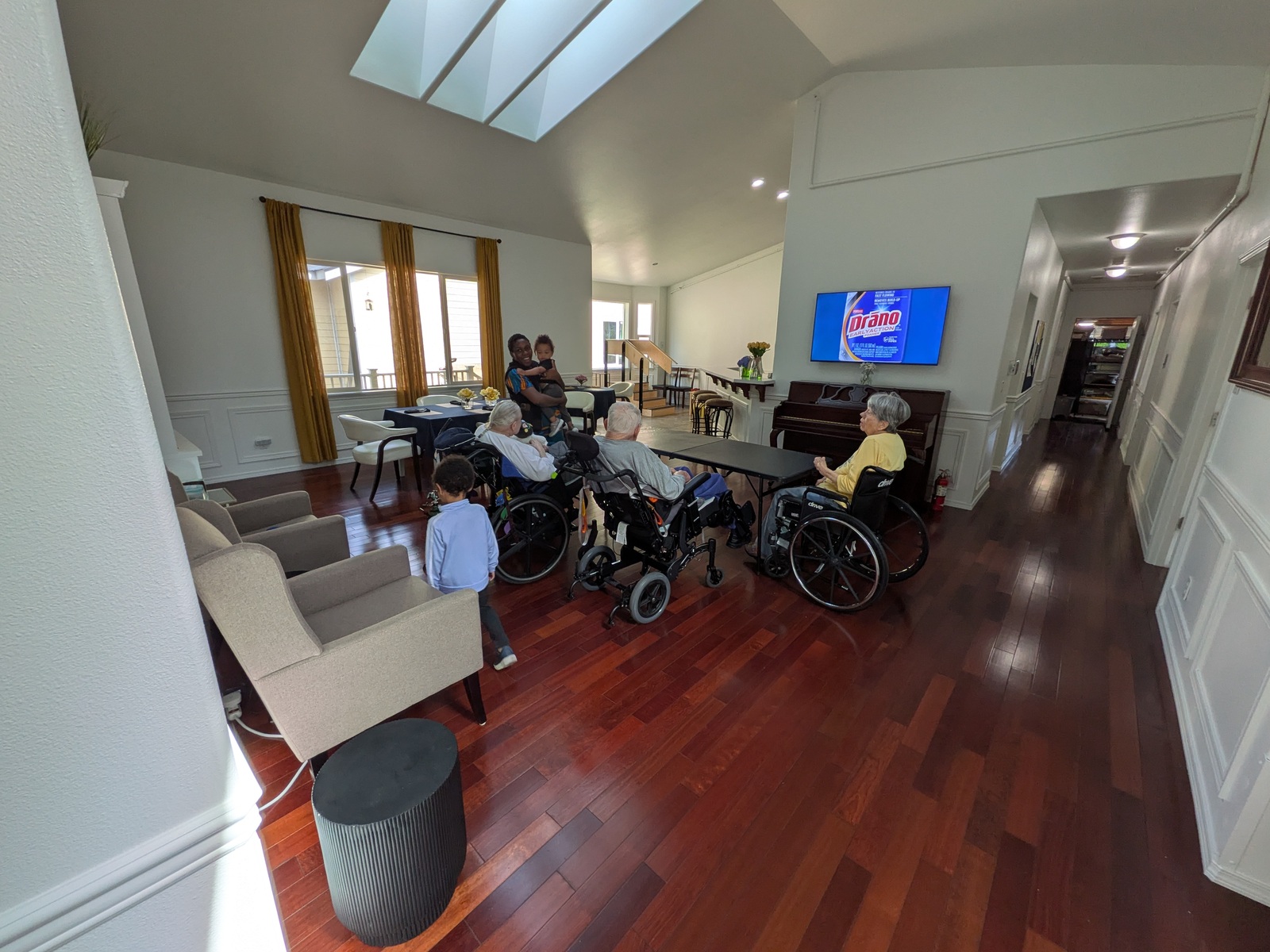
A care home is where your loved one will live, not just be supervised — quality of life is the point. Ask about the rhythm of an ordinary day and whether it matches the person you know.
- ☐ Ask what a typical day looks like: when residents wake, eat, socialize, rest, and go to bed.
- ☐ Ask what activities and outings the home offers, and whether they're tailored to residents' interests and abilities rather than a one-size-fits-all calendar.
- ☐ Ask about privacy and personal space: can residents personalize their rooms, keep belongings, and close their door?
- ☐ Ask about visiting hours: are family visits genuinely welcome, or is visiting constrained by a schedule?
- ☐ Ask how residents who prefer solitude or quiet are respected in a shared home.
7. Communication with Families
Good care doesn't end at the door — it includes keeping the people who love the resident informed. Communication habits are also a reliable signal of how the home actually operates day to day.
- ☐ Ask how families receive updates: scheduled calls, written notes, or updates only when something goes wrong?
- ☐ Ask who the family's point of contact is, and how quickly calls and messages are returned.
- ☐ Ask how the home handles changes in condition: who calls the family first, and how soon?
- ☐ Ask about care conferences: when the care plan changes, are families included in the conversation?
- ☐ Ask whether the home is transparent about mistakes — and how it reports them.
Pay attention to how a home responds to hard questions during your tour. A provider who answers directly is demonstrating the transparency you'll need; a provider who deflects is previewing your future.
8. Finances & Payment
Money is the least comfortable part of this conversation and one of the most important. Washington State adult family home costs typically range from $4,500 to $9,000 per month depending on care level, room type, and location — with RN-supervised, high-acuity homes at the higher end, reflecting a real difference in what's being delivered.
- ☐ Ask for the monthly rate in writing, and a written list of what's included (room, board, laundry, care, activities) and what's extra.
- ☐ Ask about move-in fees, deposits, and notice requirements — what happens if care needs change?
- ☐ Ask whether the home accepts COPES or CFC Medicaid waivers for personal care services.
- ☐ Ask whether the home works with VA Aid and Attendance benefits for veterans and surviving spouses.
- ☐ Ask whether long-term care insurance applies, and whether the home will complete the paperwork.
- ☐ Ask what happens to the rate if the resident's care level increases.
Because the intersection of Medicaid, long-term care insurance, and veterans' benefits is genuinely complex, consult a benefits counselor before ruling any option out. A reputable home will discuss finances plainly and in writing.
9. Red Flags That Should End the Conversation
Some issues are not fixable by you, and they are not worth hoping will improve. Any one of these should stop a decision in its tracks:
- 🚩 The home cannot produce a current DSHS license number immediately. There is no acceptable reason for this.
- 🚩 Vague answers about staffing, especially overnight coverage, or a refusal to give exact numbers.
- 🚩 A pattern of inspection deficiencies with no documented corrections.
- 🚩 High turnover among caregivers or residents — instability in either is a warning sign.
- 🚩 Staff who cannot describe how they'd handle an emergency related to your loved one's condition.
- 🚩 A tour that feels rushed or scripted, or staff who discourage questions.
- 🚩 A home that is unwilling to show you everything, including bedrooms, bathrooms, and the kitchen.
- 🚩 Residents left unattended, strong odors, or caregivers who don't seem to know residents' names.
- 🚩 Any pressure to sign anything before you're ready.
These aren't judgment calls. They're the difference between a care environment and a gamble. Trust what you see over what you're told, and walk away when you need to — a good home will never make you feel rushed.
Frequently Asked Questions
What should I check first when touring an adult family home in Washington?
Start with licensing. Confirm the home holds a current, active DSHS license and verify it yourself using the DSHS Residential Care Facility Search tool. Review the last two inspection reports before you arrive, then use your tour to test the details — staffing ratios, overnight coverage, medication protocols, and emergency plans.
How do I verify an adult family home's license in Washington State?
Every licensed adult family home in Washington operates under RCW 70.128 through DSHS. Ask for the license number, then look it up in the DSHS Residential Care Facility Search tool to confirm it is active and unencumbered. If a home cannot produce a current license number immediately, it is not legally permitted to provide personal care to unrelated adults.
What staff-to-resident ratio should I look for?
Washington requires a minimum ratio of one caregiver per six residents in an adult family home, and many homes operate at 1:3 or better with live-in caregivers. Always ask for the specific number during the day and again overnight — coverage at 2 a.m. matters as much as coverage at 2 p.m.
How do I know if an adult family home can handle my loved one's medical needs?
Ask exactly how the home manages your loved one's specific conditions — medication timing, tube feeding, dialysis, mobility, or complex neurological needs — and ask who supervises those tasks. RN-owned and operated homes like Edmonds Villa provide licensed nursing oversight for high-acuity conditions that standard homes cannot accommodate.
What should I ask about medication management?
Ask who administers medications, how errors are tracked and reported, how the schedule is kept accurate, and what happens if a resident refuses a dose. For conditions like Parkinson's, where medication timing is critical, ask how the home guarantees on-time administration.
How much does an adult family home cost in Washington State?
Monthly rates typically range from $4,500 to $9,000 depending on care level, room type, and location. Homes with RN supervision and high-acuity capabilities sit at the higher end. Ask for a written breakdown of what is included and what is extra, and explore COPES, CFC, VA Aid and Attendance, and long-term care insurance.
What are the biggest red flags when choosing an adult family home?
Refuse any home that cannot produce a current DSHS license number. Be equally cautious about vague answers on overnight staffing, a pattern of inspection deficiencies without correction, high staff or resident turnover, and staff who cannot describe how they would handle an emergency related to your loved one's condition.
The Right Home Passes the Checklist — and Feels Like Home
No checklist can make this decision easy, but it can make it clear. Work through the categories, write down real answers, and compare homes side by side — on licensing before anything else, then on the care details that will shape your loved one's every day: staffing consistency, medical capability, safety systems, food, communication, and honest numbers.
And remember that the checklist is a floor, not a ceiling. The right adult family home won't just satisfy the items on it — it will also feel like a place where your parent or spouse could genuinely live. Edmonds Villa is an RN-owned high-acuity adult family home in Edmonds, Washington, licensed for up to six residents and equipped to manage the complex medical needs most homes cannot. If you'd like to see how a checklist plays out in practice, schedule a tour — we'll answer every question on it, honestly.