When a hospital social worker, doctor, or discharge planner says your parent "needs skilled nursing care," it's easy to hear only one word: nursing home. And for many families, that word carries real weight — long institutional hallways, rotating shifts, a clinical setting that feels like an ending rather than a next chapter. The conversation often frames the choice as binary: manage at home with whatever help you can arrange, or move into a large skilled nursing facility. But in Washington State, a third option deserves a much closer look: the licensed adult family home, a single-family house in an ordinary neighborhood where up to six adults receive daily care, supervision, meals, and — in the right home — genuinely advanced medical support. For families researching a nursing home alternative, this is the option almost never mentioned first, and it changes the shape of the decision.
This guide compares the two models side by side so you can weigh them honestly: how each is licensed, how much capacity and staffing each provides, the medical needs each is equipped to handle, what each costs, how families pay, and what daily life actually feels like in each setting. If you're new to adult family homes, start with our complete guide, What Is an Adult Family Home?, then come back here for the comparison.
Two Models, Two Philosophies: The Basics
Both settings provide housing, meals, supervision, and personal care to adults who can no longer live fully independently. From there, the two models diverge in nearly every dimension of day-to-day life.
What an adult family home is
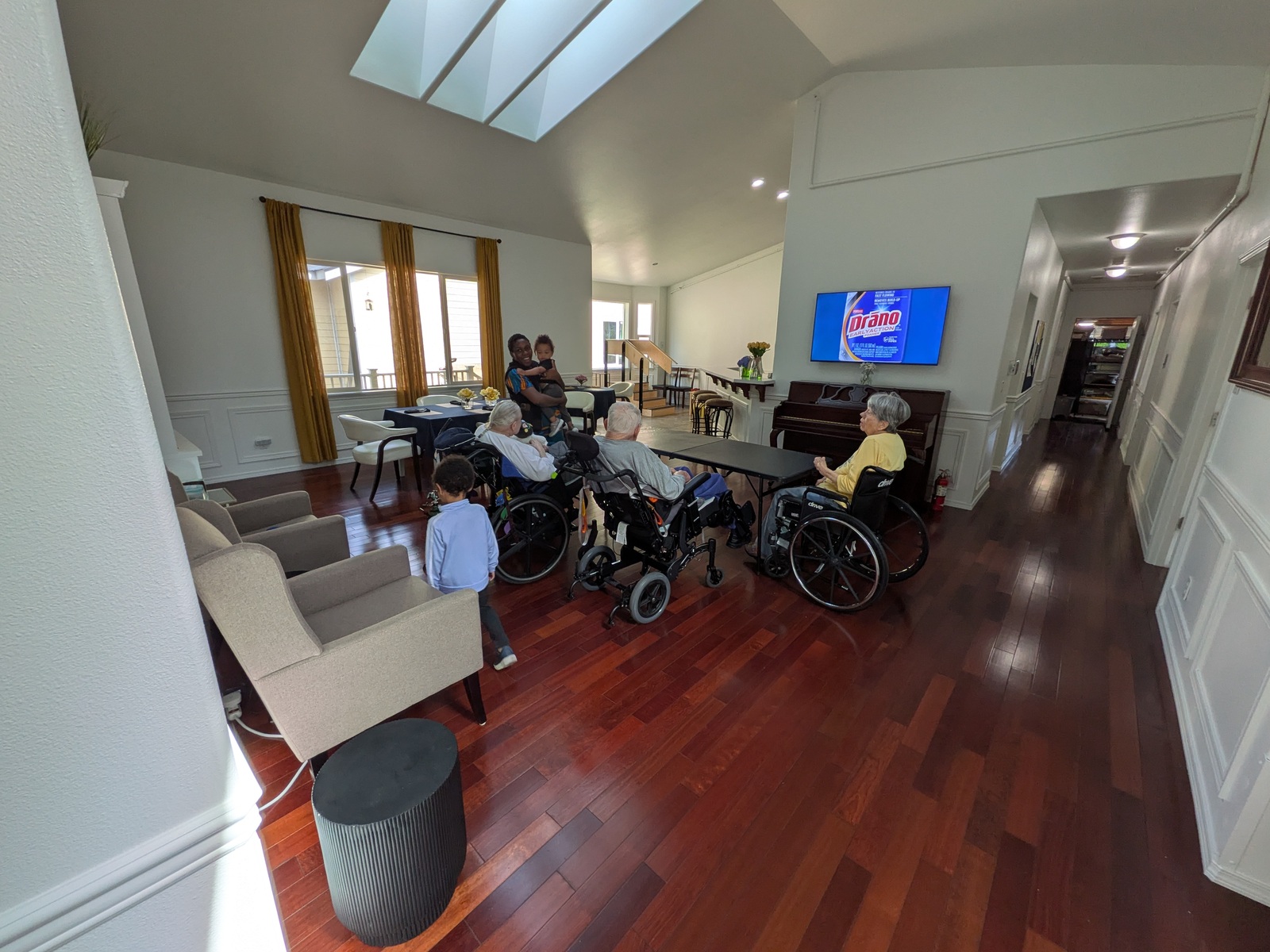
An adult family home (AFH) is a licensed residential care home in a single-family house. Under Washington law, DSHS licenses these homes to care for a small number of adults — six at the standard license — providing room and board, personal care, medication support, and 24-hour supervision. The caregivers are consistent, the residents know each other, and meals happen at a shared table. It is, in the truest sense, a home on a residential street.
What a nursing home is
A nursing home — formally a skilled nursing facility (SNF) — is a licensed health care facility that provides 24-hour skilled nursing care, rehabilitation therapy, and medical supervision. It is a facility by design: units, shifts, clinical staff, and a building organized around medical care rather than domestic life. Nursing homes sit at the highest-acuity end of the residential care continuum, and they are essential for residents whose needs can only be met by around-the-clock licensed nursing and regular medical oversight.
The two models at a glance
| Factor | Adult Family Home | Nursing Home (SNF) |
|---|---|---|
| Setting | Single-family house in a residential neighborhood | Licensed facility / campus designed for medical care |
| Capacity | Up to 6 residents (7–8 only with an enhanced license) | Typically 60–150+ residents |
| Staffing | 1:6 minimum; often 1:3 or better with consistent caregivers | Facility-wide nursing ratios with rotating shifts |
| Nursing oversight | RN-supervised at high-acuity homes | 24/7 licensed nursing (RN, LPN, CNA) and medical direction |
| Medical scope | Personal care to high-acuity chronic care | Skilled nursing, rehabilitation, post-acute care |
| Typical monthly cost | $4,500 – $9,000 | Commonly well above $10,000 |
| Daily feel | Homelike, calm, low-stimulation | Clinical, structured, institutional |
How Washington State Licenses Each Setting
Adult family home licensure under RCW 70.128
Washington licenses adult family homes through the Department of Social and Health Services under RCW 70.128. Providers must complete 75 hours of basic long-term care training plus a 48-hour AFH Administrator course before accepting any residents, pass the Home Care Aide certification exam, clear state and federal background checks, and carry liability insurance. Routine inspections occur roughly every 15 months and are unannounced; inspectors review resident care plans, medication records, staffing documentation, emergency preparedness, building safety, and resident dignity. Inspection reports are public through the DSHS Residential Care Facility Search tool, and every family should review them before touring.
Nursing home licensure and federal certification
Nursing homes are licensed by DSHS under Washington's nursing home regulations (RCW 18.51), and because the vast majority participate in Medicare and Medicaid, they must also meet federal certification standards administered by the Centers for Medicare & Medicaid Services (CMS). That federal layer brings stricter clinical requirements: physician oversight, required licensed nursing coverage around the clock, formal interdisciplinary care planning, and periodic federal surveys. The regulatory burden is heavier — appropriately so, given the acuity of the residents served — but the result is a more clinical, more institutional environment. Either way, the first step in evaluating any option is the same: verify an active license through DSHS.
Capacity and Staffing: The Numbers That Matter
In an adult family home, the ratio is personal
The standard AFH license caps the home at six residents; a small number of homes hold an enhanced license for seven or eight, but only under strict conditions. That ceiling is the whole point. Caregivers work with a handful of people they know by name, by routine, and by medical history. Washington requires a minimum 1:6 staff-to-resident ratio, and most homes — with live-in caregivers and owner-operators — effectively run at 1:3 or better. At a high-acuity home like Edmonds Villa, where the owner is an RN, nursing oversight is woven into every shift rather than delivered by rotating staff or contracted out.
In a nursing home, care is organized around shifts and units
A typical skilled nursing facility houses dozens to well over a hundred residents across multiple units. Care is provided around the clock by registered nurses, licensed practical nurses, and certified nursing assistants, with a medical director and attending physicians. That is real clinical firepower — but it is distributed across a large census, and individual residents are cared for by a rotation of staff across different shifts. For someone who needs intensive, continuous clinical monitoring, that coverage is essential. For someone who primarily needs consistent, personalized daily help, it can feel distant and impersonal.
The Medical Capability Spectrum
What a nursing home is genuinely built for
The nursing home's strength sits at the top of the medical spectrum: 24/7 licensed nursing, rehabilitation therapies, IV medications, complex wound care, and post-acute recovery after surgery or hospitalization. If your loved one is medically unstable, recently discharged from the hospital, or needs therapy sessions several times a day, a skilled nursing facility is often the appropriate — and sometimes the only — setting.
What a high-acuity adult family home can handle
Standard adult family homes provide personal care, medication assistance, and intermittent nursing support. But a small tier of Washington homes — Edmonds Villa among them — operates at a much higher clinical level within a residential structure. RN-owned and RN-operated, Edmonds Villa manages conditions that force residents out of most care homes and many assisted living communities: Parkinson's disease with medication timing accurate to the minute, peritoneal dialysis and home hemodialysis, G-tube and J-tube feeding, bariatric care with specialized transfer equipment, oncology symptom management, complex metabolic conditions, and cardio-pulmonary care. Explore the full range of what we can provide on our services page.
The honest boundary between the two
The distinction that matters most: a high-acuity adult family home is designed for complex, chronic conditions that are stable and manageable in a home with RN oversight and visiting clinicians. A nursing home is the setting for acute, unstable, or intensive rehabilitation needs — a recent surgery, IV therapy, an aggressive recovery plan, or a medical crisis requiring continuous clinical monitoring. The two are not competitors in every case; they are different tools for different phases of a loved one's journey.
Unsure which level of care your loved one actually needs? Edmonds Villa's RN team can help you understand what's genuinely required — and whether our home is the right fit for you. Contact us for an honest assessment.
Who Each Setting Is Designed For
Nursing homes serve the highest-acuity residents
Skilled nursing facilities are designed for adults who need continuous licensed nursing and medical supervision: people recovering from hospitalization, surgery, or stroke; residents requiring rehabilitation therapy; and individuals with advanced, unstable conditions that demand clinical monitoring around the clock. Many nursing home residents stay short-term for rehabilitation and then discharge to home or a less intensive setting.
Adult family homes serve people who need care, not institutionalization
An adult family home is designed for adults who need consistent daily help and supervision but do not need hospital-level structure — and who would fare better in a calm, familiar, low-stimulation home. That includes people with dementia or cognitive decline, mobility limitations, and stable chronic conditions. High-acuity adult family homes extend that population to include people with complex medical needs who might otherwise be told the only option is a nursing home.
Where the populations overlap
There is genuine overlap. A person with advanced Parkinson's, for example, could receive care in either setting. The right answer depends on medical stability, intensity of need, and the kind of life the person wants to live day to day. For the fuller comparison, see adult family home vs. assisted living.
Cost and How Families Pay
Monthly costs compared
In Washington State, adult family homes typically range from $4,500 to $9,000 per month, with RN-supervised high-acuity homes sitting toward the higher end. In the Seattle area and across Snohomish County, rates tend toward the upper part of that range. Skilled nursing facilities are generally the most expensive residential setting, with private-pay rates commonly running well above $10,000 per month. For residents with complex but stable needs, the difference can be substantial — and a high-acuity adult family home provides nursing-level oversight within that lower price range.
Payment sources
Most families begin as private pay, but several programs can help. Washington's COPES Medicaid waiver can cover personal care services for qualifying residents of adult family homes, with room and board typically paid from the resident's monthly income. Community First Choice (CFC) offers similar personal care coverage without a waitlist. Veterans and their spouses may qualify for the VA Aid and Attendance benefit, which can offset monthly costs. Medicare does not pay for long-term residential care, but it does cover short-term skilled nursing facility stays after a qualifying hospital admission; Medicaid can cover long-term nursing home care for eligible residents. Long-term care insurance policies often apply to either setting.
One caution worth repeating: eligibility for Medicaid, veterans' benefits, and long-term care insurance is genuinely complex. Speak with a benefits counselor and your financial advisor before assuming any payment path is unavailable — these programs are more generous, and more conditional, than families often assume.
Quality of Life: A Home vs. an Institution
Life in a nursing home is structured around the facility
Nursing homes run on schedules that serve clinical efficiency: set meal times in a central dining room, programmed activities, and rotating staff across shifts. The environment is designed to be safe and clinical — wide corridors, handrails, nursing stations, semi-private rooms. For residents who genuinely need the structure and monitoring, it is the right place. But it is unmistakably an institution, and for a person with dementia or a strong need for calm, that environment can be over-stimulating.
Life in an adult family home is structured around the person
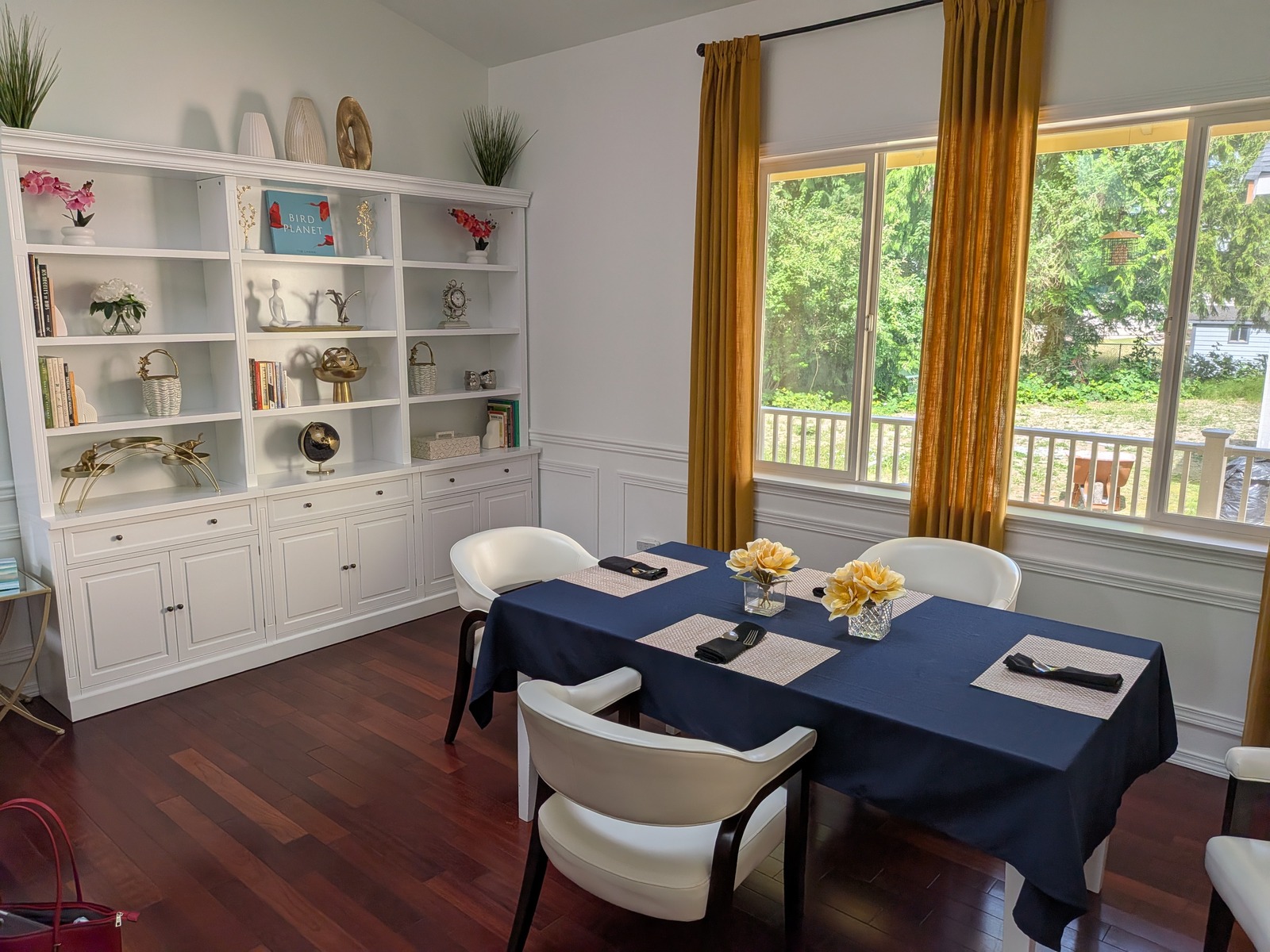
An adult family home is a house. Meals are cooked in a shared kitchen and eaten at a family table. Residents keep their own rhythm — when to rise, what to eat, how to spend the day — and a small, consistent care team learns and honors those rhythms. Outings, gardening, and small-group activities happen organically rather than on a facility-wide activity calendar. For residents with cognitive decline, the calm and familiarity are themselves part of the therapy. And families visit the way they would visit a loved one's home, not a unit on a floor. The model's real value shows up not in a brochure, but in the texture of ordinary days.
When Each Is the Right Choice
When a nursing home is the right choice
- Recent hospitalization or surgery requiring skilled nursing care or rehabilitation therapy
- Acute, unstable, or rapidly changing medical conditions that demand 24/7 licensed nursing and physician oversight
- IV therapy, complex wound care, or an intensive, time-limited rehab plan
- A short-term post-acute stay with a plan to transition home or to a less intensive setting
When an adult family home is the right nursing home alternative
- Complex but stable chronic conditions — Parkinson's, dialysis, tube feeding, bariatric care — manageable with RN oversight and visiting clinicians
- Dementia or cognitive decline that thrives in a calm, familiar, low-stimulation setting
- A preference for a homelike environment with consistent caregivers who truly know the resident
- The desire to age in place rather than face disruptive transfers as care needs increase
- Cost-conscious families who want nursing-level oversight at a lower monthly rate
The aging-in-place advantage
One of the most important differences families discover only after placement is what happens when needs escalate. In many settings, escalating needs trigger a discharge to a nursing home — a move that is physically and emotionally hard on the resident. A high-acuity adult family home is built to hold residents as their conditions progress, which is precisely why so many families now ask about adult family homes first when a nursing home placement is proposed. For more on the model in the Seattle area, see our guide to small care homes in Seattle as nursing home alternatives.
Frequently Asked Questions
What is the main difference between an adult family home and a nursing home in Washington State?
The main difference is scale and the level of medical care provided. An adult family home is a licensed residential care home in a single-family house, caring for up to six adults with personal care, meals, supervision, and a homelike setting. A nursing home (skilled nursing facility) is a larger licensed facility that provides around-the-clock skilled nursing care, rehabilitation, and medical oversight for residents who need intensive, ongoing clinical support.
Is an adult family home a good alternative to a nursing home?
For many families, yes. Adults with stable chronic conditions — dementia, Parkinson's disease, dialysis needs, tube feeding, or complex medication management — can often receive excellent care in a high-acuity adult family home at a lower cost and in a far more homelike setting. A nursing home remains the appropriate setting for acute, unstable, or post-hospital care that requires 24/7 licensed nursing.
Do adult family homes provide skilled nursing care?
Standard adult family homes provide personal care, medication assistance, and intermittent nursing support. High-acuity adult family homes like Edmonds Villa go further: RN-owned and operated, they manage complex conditions including Parkinson's, dialysis support, enteral feeding, bariatric care, and oncology symptom management through licensed nursing services and nurse delegation.
Which is more expensive — an adult family home or a nursing home?
Adult family homes typically range from $4,500 to $9,000 per month in Washington State. Skilled nursing facilities are generally significantly more expensive, with private-pay rates commonly running well above $10,000 per month. For residents with complex but stable medical needs, a high-acuity adult family home can provide nursing-level oversight in a home setting at a lower monthly cost.
Does Medicare or Medicaid pay for care in either setting?
Medicare covers short-term skilled nursing facility stays (up to 100 days) after a qualifying hospital stay, but does not cover long-term residential care in an adult family home. Medicaid, through Washington's COPES waiver and Community First Choice (CFC) program, can help cover personal care services in adult family homes for qualifying residents. Medicaid also covers long-term nursing home care for eligible residents.
How do I decide between an adult family home and a nursing home for my parent?
Start with medical need and stability. If your parent is recovering from a hospital stay, needs intensive rehabilitation, or has unstable medical conditions, a nursing home may be required. If they have a stable chronic condition and need consistent daily help, an adult family home — especially a high-acuity one — offers personalized care in a residential setting where every resident is genuinely known.
Can a resident move between an adult family home and a nursing home if needs change?
Yes. Transitions happen in both directions. A resident may spend time in a skilled nursing facility after surgery and return to an adult family home for ongoing care. High-acuity adult family homes reduce the need for disruptive transfers in the first place, because they can manage complex conditions that would otherwise force a move to a larger facility.
Choosing the Right Care Is About the Life You Want to Protect
The comparison between an adult family home and a nursing home is not a ranking of which is "better." Each model exists because a real population of residents needs exactly what it provides. A nursing home is the right setting for acute, intensive, or post-hospital care that only a licensed medical facility can deliver. For adults with complex but stable needs — and for families who want their loved one to receive skilled care without surrendering the feeling of home — a high-acuity adult family home is a genuinely strong nursing home alternative.
The practical path is the same in both cases: verify licensing, read inspection reports, tour the setting, and ask hard questions about staffing, medication management, and what happens when needs change. If you're weighing an adult family home, start with DSHS licensing and a conversation with the RN who runs the home. At Edmonds Villa, that conversation is a good place to begin.