Most searches for a small care home in Seattle start the same way — not with a plan, but with a worry. A parent who needs more help than home care can safely provide. A spouse whose condition has outgrown what one person can manage at home. A discharge planner telling you skilled care is required, while the only options on the table feel too large, too clinical, or too far from everything that feels like home.
If that sounds familiar, the good news is that a small care home sits in the space between those two extremes — and in Washington State, it is a fully licensed, regulated model of residential care. It is a real house on a residential street, licensed under RCW 70.128 for up to six adults, with caregivers who know every resident by name and a care plan built around the actual person living there. It is not a facility with wings and rotating shifts. It is a home with a care team.
Not all small care homes are created equal, though. Some provide warm, attentive personal care but cannot safely support complex medical conditions. Others — like Edmonds Villa in Edmonds, Washington — are licensed and staffed for high-acuity care, meaning they can manage conditions most residential homes cannot: advanced Parkinson's, dialysis, tube feeding, bariatric care, and more. This guide explains what small care homes offer, how they compare to nursing homes and large facilities, how to find one near Seattle, and what to look for before you say yes.
What Is a Small Care Home, Really?
Call it a small care home, a residential care home, or by its legal name, an adult family home — the model is the same. In Washington State, it is a licensed single-family residence in an ordinary neighborhood where a small number of adults receive room, board, personal care, medication assistance, and 24-hour supervision from a consistent care team. The legal framework is RCW 70.128, and the homes are licensed and inspected by the Department of Social and Health Services (DSHS).
Capacity is the structural heart of the model. The standard license permits up to six residents, and that ceiling is exactly why these homes can deliver what larger settings cannot: individualized attention at a human scale. Meals are cooked in the same kitchen the residents live in. Caregivers work the same shifts week after week. A resident's day is shaped around their preferences, not a facility-wide schedule printed at the front desk.
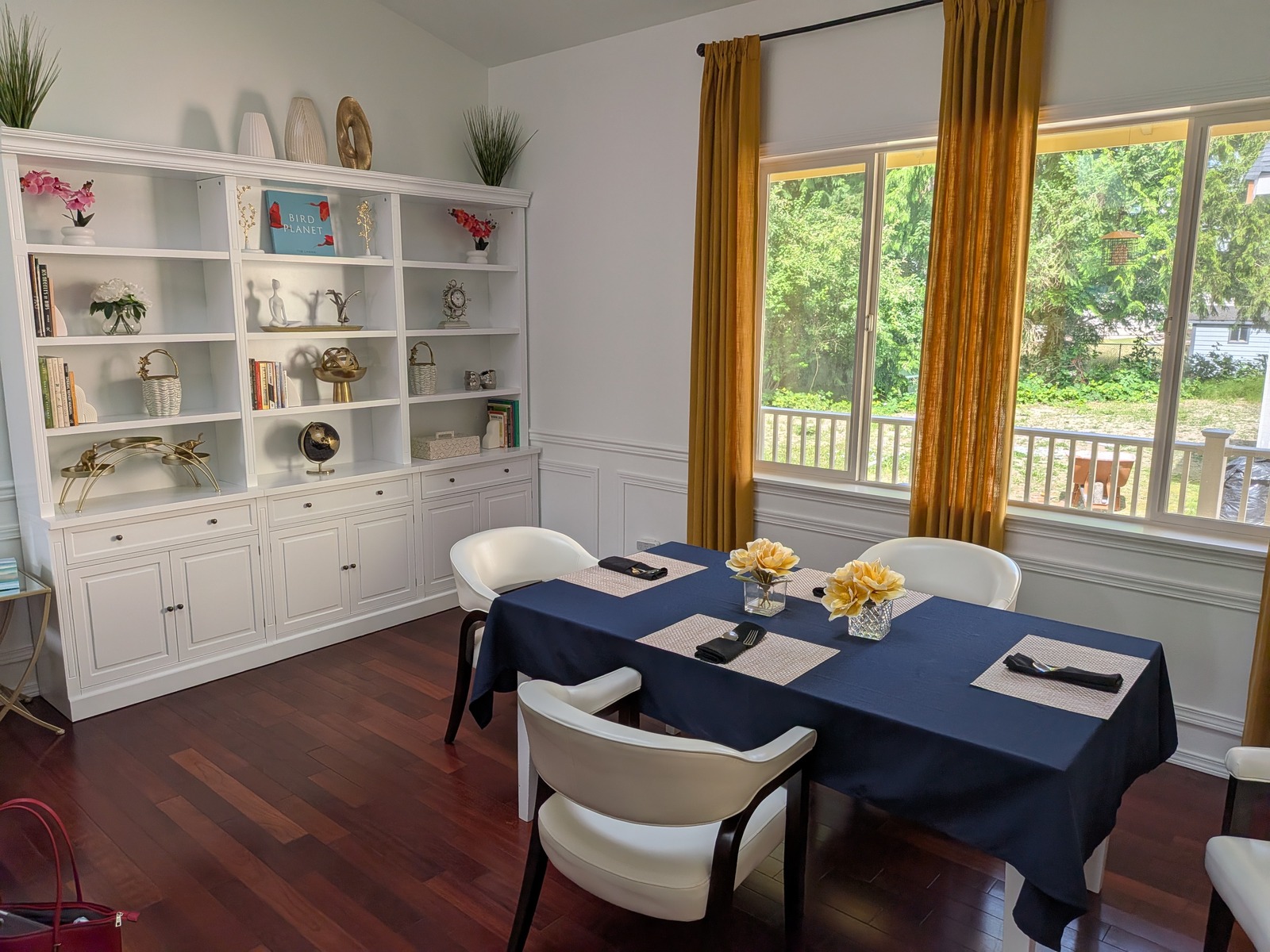
This is the same model our complete Washington State guide to adult family homes explores in depth, from licensing to costs. What matters here is the category itself: small homes are a distinct and legitimate option on the care continuum, and for the right family they are often the better one.
What a Small Care Home in Seattle Offers That a Large Facility Can't
For the adult children researching these homes, the appeal usually comes down to four things:
- Consistent caregivers. In a six-bed home, the same few people care for a resident every day. They learn the sleep patterns, the medication timings, the small preferences that make a person feel respected rather than processed. In larger facilities, staffing rotates and residents interact with a stream of unfamiliar faces.
- Better staff-to-resident ratios. A handful of caregivers for six residents is a fundamentally different ratio than a floor of forty rooms covered by a shift team. More of each caregiver's attention lands on each resident, and that attention is the actual product of care.
- Personalized care plans. Every resident has a negotiated care plan developed at admission and updated as their condition changes. At this scale, the plan reflects the person — their routines, their history, their preferences — rather than a diagnosis category.
- A homelike, calmer environment. For residents with dementia, cognitive decline, or a strong need for predictability, the absence of institutional noise and unfamiliar faces is itself therapeutic. Familiar surroundings and steady routines reduce agitation and anxiety.
Because every resident is known, caregivers notice the small changes — a waning appetite, a shift in mood, a rougher night's sleep — that are often the earliest signals that a condition is changing. In a building with forty or a hundred residents, those signals are far easier to miss, and an unnoticed change is a missed chance to intervene early.
For a detailed comparison of this model against assisted living apartments, our guide to adult family homes vs. assisted living walks through the differences in size, staffing, and daily experience. Here, the focus is narrower: how small homes measure up against the larger, more medical settings families are often steered toward.
Small Care Homes vs. Nursing Homes: What the Difference Means
Where a nursing home is a medical facility, a small care home is a home with medical capability. Both can care for complex conditions; the difference is scale, staffing model, and daily experience.
A skilled nursing facility is built around a medical model: more residents, a larger clinical staff, rotating shifts, and schedules organized around institutional efficiency. That structure exists for a reason — it is what allows a facility to run hundreds of beds — but it comes with real trade-offs. Residents share caregivers with many others, care is delivered in shifts rather than by a team that knows them personally, and the environment is unavoidably institutional.
A small care home inverts that logic. Instead of bringing many residents to one large building, it keeps a handful of residents in a house and brings the necessary clinical capability to them. For the person living there, the difference is daily and felt: sleeping in a real bedroom, eating at a shared table, and being known by the people providing care.
The honest caveat is that a nursing home is genuinely necessary in some situations — when a condition requires around-the-clock licensed nursing care at a skilled-nursing level, for example, or continuous professional oversight that a residential setting cannot safely provide. But many families are steered toward nursing homes not because the level of care demands it, but because no one told them a high-acuity small home could meet their loved one's needs. Our detailed comparison of adult family homes vs. nursing homes in Washington State covers that distinction thoroughly, including which situations genuinely require skilled nursing.
Can a Small Care Home Handle Complex Medical Needs?
The short answer is: yes — if you choose the right home. The longer answer matters, because it's where most families make their decision.
Most adult family homes in Washington are licensed for personal care, medication assistance, and intermittent nursing support. That covers a great deal of daily need, but it has limits. Conditions like advanced Parkinson's disease, dialysis dependency, tube feeding through a G-tube or J-tube, bariatric care requiring specialized transfer equipment, and oncology symptom management require trained nursing oversight, specialized equipment, and detailed clinical protocols. Many small homes cannot safely provide that level of care.
That's where high-acuity care comes in. A high-acuity adult family home coordinates licensed nursing services for complex conditions while preserving the residential environment families prefer. Edmonds Villa is a DSHS-licensed, RN-owned and operated high-acuity adult family home in Edmonds — the RN ownership means clinical decisions are made by someone with direct medical accountability, not deferred to administrative staff.
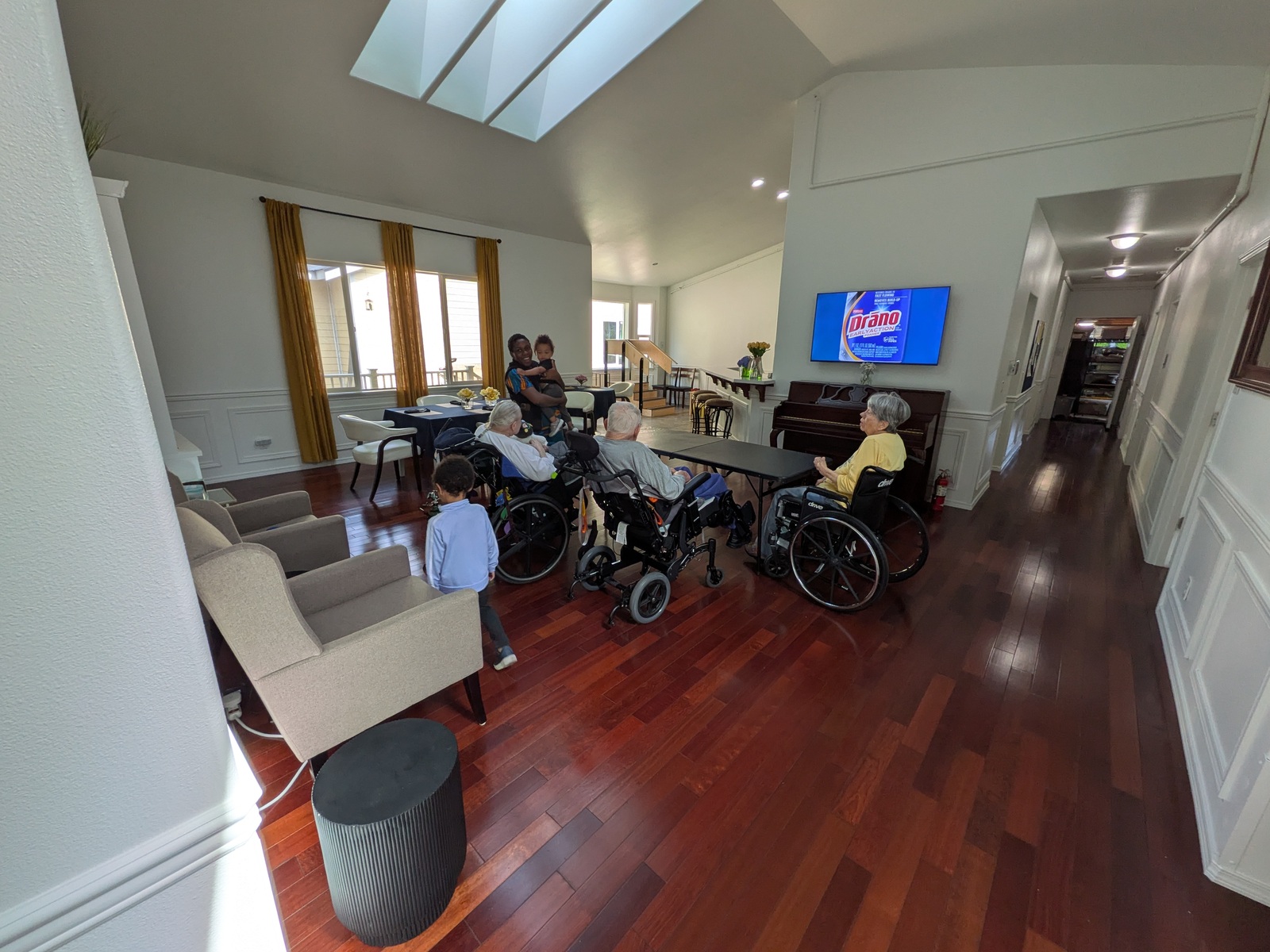
The conditions Edmonds Villa is equipped to manage include:
- Neurological care for Parkinson's, ALS, and related conditions — precise medication timing, fall prevention, and coordination with neurologists
- Dialysis support coordinated through licensed nursing services, including peritoneal dialysis and home hemodialysis under appropriate clinical supervision
- G-tube and J-tube feeding with proper nutrition protocols and trained oversight
- Bariatric care with appropriate transfer equipment and trained staff
- Oncology symptom management and treatment support in coordination with the resident's medical team
- Complex metabolic care and cardio-pulmonary management under nursing supervision
Edmonds Villa also offers spousal room and board, which lets a well spouse live alongside a partner who needs high-acuity care. For couples who have built a life together and won't accept living apart just because one of them needs medical support, that single feature can change the entire shape of the decision.
Does your loved one need more than a standard small care home can provide? Edmonds Villa specializes in the complex medical conditions most adult family homes cannot accommodate. Contact us to discuss whether we're the right fit for your family.
How to Find a Small Care Home Near Seattle
Seattle and the surrounding region are home to hundreds of licensed adult family homes. Edmonds, Shoreline, Lynnwood, Mountlake Terrace, Bothell, and Seattle proper all have options, and neighborhoods within the city are dotted with them. Because these are houses rather than commercial buildings, you'll often find them simply by driving through a residential area — but the reliable way to search is structured, not serendipitous.
Start with the DSHS Residential Care Facility Search tool, which lists every licensed provider and its current status. Before you tour anything, confirm two things: the license is active, and the provider name matches. If a home cannot immediately produce a current DSHS license number, it is not legally permitted to provide personal care to unrelated adults in Washington State. That's not a technicality; it's a safety issue.
Pull up the last two inspection reports for any home you're seriously considering. Inspection reports are public, and they tell you how a home actually operates under scrutiny — deficiency patterns, corrective actions, and whether issues get resolved. A home with clean inspections and a culture of accountability reveals itself in these records long before a tour does.
Because small homes accept so few residents, the good ones fill quickly. Begin your search earlier than you think you need to, and plan to tour two or three homes rather than deciding from a single visit. And once you're looking at specific homes, our ultimate adult family home checklist for families lays out exactly what to verify and ask at each stage of the search.
What to Look for When You Visit
The quality of a small care home reveals itself through the specificity of its answers. On every tour, ask:
- Who holds the DSHS license, and what is their clinical background? Is there RN ownership or supervision?
- What is the caregiver-to-resident ratio during day shifts, and again overnight?
- How are care plans developed, who participates, and how often are they updated?
- What is the protocol if a resident's condition deteriorates significantly?
- How would this home specifically handle your loved one's condition, from medication timing to emergency response?
A provider who answers these directly and without defensiveness is demonstrating the transparency that builds trust over time. A provider who can't clearly describe how they'd handle a medical emergency related to your loved one's condition hasn't thought that scenario through — and should not be trusted with it.
Then watch how staff interact with residents, not just how they present information to you. Do caregivers address residents by name? Is the pace calm or hurried? Does the home feel clean and genuinely lived-in rather than staged for the tour? These observations tell you more than any brochure.
The red flags are consistent across the industry: no license number available, vague answers about overnight staffing, a pattern of enforcement actions without documented corrective steps, and high turnover among residents or staff. Any one of these should stop a decision in its tracks.
What a Small Care Home Costs in Washington State
Monthly costs for adult family homes in Washington typically range from $4,500 to $9,000, depending on care level, room type, and location. Standard personal care homes sit toward the lower end. Homes with RN supervision, specialized equipment, trained staff for high-acuity conditions, and documented clinical protocols sit toward the higher end — and that difference reflects a genuine difference in what's being provided.
Most families begin as private pay. Washington State's COPES Medicaid waiver can cover personal care services for qualifying residents, though it does not cover room and board. The Community First Choice (CFC) program offers similar coverage without a waitlist for eligible individuals. Veterans and their spouses may qualify for the VA Aid and Attendance benefit, which can meaningfully offset monthly costs. Long-term care insurance, where it exists, often applies to adult family home placement directly.
Before assuming any payment option is unavailable, consult both a financial advisor and a benefits counselor — the intersection of Medicaid eligibility, insurance policy language, and veterans' benefits is genuinely complex, and getting it wrong can cost tens of thousands of dollars a year.
Frequently Asked Questions
What is a small care home in Seattle?
A small care home is the everyday name for a licensed adult family home — a single-family house where up to six adults receive personalized daily care, meals, supervision, and medical support under Washington's RCW 70.128 licensing framework. The defining features are size and relationship: a handful of residents, consistent caregivers, and a genuinely homelike setting.
How is a small care home different from a nursing home?
A nursing home is a skilled nursing facility built around a medical model, with more residents, rotating staff, and institutional schedules. A small care home serves up to six residents in a residential house with consistent caregivers who know each person. High-acuity adult family homes like Edmonds Villa can manage complex medical needs that would otherwise point families toward skilled nursing.
Can a small care home handle complex medical needs?
Yes — though not every small care home can. A standard adult family home provides personal care, medication assistance, and intermittent nursing support. A high-acuity AFH, like RN-owned Edmonds Villa, adds structured clinical capability for conditions such as Parkinson's disease, dialysis, tube feeding, bariatric care, and oncology symptom management.
How much does a small care home cost in Washington State?
Monthly costs typically range from $4,500 to $9,000 depending on care level, room type, and location. Small care homes with RN supervision and high-acuity capabilities sit at the higher end. Payment options include private pay, the COPES Medicaid waiver, Community First Choice (CFC), VA Aid and Attendance, and long-term care insurance.
How do I find a licensed small care home near Seattle?
Use the DSHS Residential Care Facility Search tool to confirm active license status and review inspection history before touring. Search by city or county — Edmonds, Shoreline, Lynnwood, and other north Seattle communities all have licensed homes — and verify the provider name and license number directly with DSHS.
Does Medicaid pay for care in a small care home?
Washington State's COPES Medicaid waiver can cover personal care services for qualifying residents, though room and board are typically paid from monthly income. The Community First Choice (CFC) program offers similar coverage without a waitlist for eligible individuals. Eligibility depends on financial and functional need.
How many residents live in a small care home?
In Washington State, the standard licensed capacity is six residents. A small number of homes hold an enhanced license for up to eight, which requires additional years of clean operating history, a residential sprinkler system, and documented financial stability. Edmonds Villa is licensed for up to six.
A Small Care Home Can Be Both the Right Level of Care and the Right Place to Live
The choice facing most families isn't really between a nursing home and a large facility. It's between a level of care and a kind of life. A small care home near Seattle offers a level of medical capability that can meet complex needs — up to and including high-acuity conditions — in a setting where your parent is a person who is known, not a resident who is housed.
Do the homework in the order it matters: verify DSHS licensing before anything else, read the inspection reports, tour with a checklist in hand, and match the home's actual capabilities to your loved one's specific medical needs. The right small care home is out there — and for many families in the Seattle area, it's closer to home, in every sense, than they expected.