When you're researching care for a medically complex parent, you end up asking questions you never imagined needing to answer. Who will give the right dose of the right medication at the right time — every single day? Who will notice the subtle change in breathing, appetite, or alertness that signals a problem before it becomes a crisis? And when your search narrows to an RN-owned adult family home, what does that actually change?
In Washington State, an adult family home is a licensed residential care home — regulated under RCW 70.128 — that provides personal care, meals, supervision, and medical support to up to six adults in a real single-family house. But "licensed" only tells you a home meets a legal baseline. It tells you nothing about the clinical background of the person who owns it and runs it. That distinction becomes everything when your loved one's needs go beyond custodial care.
Some homes are operated by administrators who coordinate care well. A smaller number are owned and operated by registered nurses, who bring a clinician's judgment to every decision that happens under their roof. Edmonds Villa, in Edmonds, Washington, is one of those homes — a DSHS-licensed, RN-owned and operated high-acuity adult family home led by Sandra Namwase, RN. If you're comparing care options near Seattle, understanding what RN ownership actually changes — clinically and practically — will sharpen every question you ask on every tour you take.
What Makes an RN-Owned Adult Family Home Different
Washington State requires every adult family home administrator to complete 75 hours of basic long-term care training plus a 48-hour AFH Administrator course, pass the Home Care Aide certification exam, and clear state and federal background checks. That is the legal floor — and it is a meaningful one. But it is not a nursing education. The difference between an administrator who has completed 123 hours of required training and a registered nurse who has completed years of clinical education, licensure exams, and supervised practice is the difference between someone who coordinates care and someone who understands the care itself.
When a home is RN-owned, that clinical background sits at the top of the organization. It shapes the medication systems, the training standards, the protocols for handling a change in condition, and the culture of the staff. It is not a credential on a wall; it is the operating model of the home. This matters at every level, but it matters most in a high-acuity care setting — where residents' conditions are medically complex precisely because standard residential care is not enough to manage them.
Direct Medical Accountability: Clinical Decisions Made by Someone with Medical Training
In many care settings, there is an invisible gap between the people who design the care and the people who deliver it. A physician or outside provider writes a care plan; staff members follow it; and nobody on site has the training to recognize when the plan no longer fits the reality of the resident in front of them. That gap is where small failures compound into big ones.
In an RN-owned home, that gap collapses. Clinical decisions are made by someone with direct medical accountability — not delegated downward to administrative staff who may lack the clinical background to recognize when a care plan needs to change. When the owner is a registered nurse, the person deciding whether to adjust a medication protocol, escalate to a physician, or pursue a particular approach to a symptom is the same person who lives with the consequences of that decision. That is a fundamentally different accountability structure from a home where clinical judgment is borrowed from an outside provider and applied at a distance.
For families, this means the person answering your hardest questions has actually made clinical decisions in real settings. It means there is no "we'll have to ask the nurse" moment — the nurse is the person you're already talking to.
Nurse Delegation: How Licensed Nursing Supervision Works in a Care Home
One of the most important — and least understood — mechanisms that makes complex care possible in a residential setting is nurse delegation. Washington State's nurse delegation framework allows a registered nurse to authorize trained caregivers to perform certain nursing tasks — administering specific medications, performing tube feeding procedures, supporting catheter care — under the RN's supervision and protocol.
The critical detail is that delegation does not transfer accountability. The RN who delegates remains responsible for the task being performed correctly. In a home where the RN visits periodically or works off-site, delegation oversight happens in bursts. In an RN-owned home like Edmonds Villa, the delegating nurse is the owner, present on site, who supervises delegated tasks continuously and can step in personally the moment a task goes beyond what a caregiver should handle.
This is the legal and clinical foundation that allows an adult family home to support services like dialysis care and enteral tube feeding — capabilities most homes simply do not hold. When you hear that a home "handles complex care," nurse delegation done properly is usually how. You can read more about what qualifies as high-acuity residential care in our guide to conditions that qualify for high-acuity care.
Medication Safety and Accuracy: Where Errors Happen — and Where They Don't
Medication errors are among the most common and most dangerous problems in residential care — a missed dose, a double dose, a crushed tablet that shouldn't be crushed, a timing shift that sends a Parkinson's resident into an "off" period for hours. The risk rises with the number of medications and the precision they require.
In an RN-owned home, medication systems are designed by someone who understands pharmacology, not just scheduling. The RN builds the administration protocols, trains the staff who administer under delegation, audits the medication records, and reviews them for patterns — a resident who has been refusing the evening dose, a drug interaction that a new prescription introduces, a timing adjustment the neurologist recommended but the care plan hasn't absorbed yet.
For residents with Parkinson's disease, whose medication timing can matter to the minute, this level of oversight is not a comfort feature; it is clinical necessity. It's why families researching care for a loved one with Parkinson's will find that an RN-led approach changes the daily experience of the disease — something our guide to Parkinson's residential care explores in depth.
Wondering whether RN-led care is the right fit for your family? Edmonds Villa is an RN-owned and operated high-acuity home that manages complex medical conditions most adult family homes cannot. Contact us to discuss your loved one's needs.
Managing Complex Conditions: Parkinson's, Dialysis, and Tube Feeding
The clearest place RN ownership shows up is in the conditions a home can actually manage. Edmonds Villa is licensed for high-acuity care and provides support for a range of medically complex conditions that most standard adult family homes cannot safely accommodate:
- Parkinson's disease and movement disorders — precise medication timing, "on-off" period monitoring, fall prevention, and coordination with neurologists
- Dialysis support — assistance with peritoneal dialysis and home hemodialysis coordinated through licensed nursing services
- Tube feeding — G-tube and J-tube feeding management under nurse delegation, with proper nutrition and hydration protocols
- Bariatric care — transfer protocols and equipment suited to higher-body-weight residents
- Oncology support — symptom management in coordination with the resident's medical team
- Complex metabolic and cardiovascular-pulmonary conditions — ongoing nursing oversight for residents who need more monitoring than standard care provides
Each of these is an area where an RN's clinical judgment directly affects outcomes — catching the early sign of peritonitis during a dialysis exchange, adjusting a tube-feeding schedule in response to digestion problems, recognizing when a Parkinson's medication change needs a faster physician call than the protocol anticipated. These are not the kinds of decisions that should live with staff members who were trained to follow a checklist. You can see the full range of what Edmonds Villa offers on our services page.
Rapid Response: When a Resident's Condition Changes, Who Notices First?
In a larger facility, a resident's change in condition is often noticed by whichever staff member happens to be on shift, reported up a chain, and responded to by someone who has never met the resident. In a six-resident home, caregivers know every resident's baseline — how they walk, how they talk, what "normal" looks like for them on a given morning — so deviations are noticed immediately.
But noticing is only half the equation. The other half is knowing what the change means and what to do next. That judgment is exactly what an RN brings to the moment. When a resident's breathing pattern shifts or their color changes, the on-site RN can assess, decide whether this is an adjust-the-care-plan situation or an emergency-room situation, notify the physician, and act — in minutes, not hours.
This rapid-response capability is what allows residents at Edmonds Villa to age in place through stages of a disease that would force a transfer out of a standard care home. Fewer unnecessary hospitalizations, fewer disruptive moves, and a care team that knows when to escalate and when not to. For families who have watched a loved one bounce between home, hospital, and facility, this continuity is one of the most tangible benefits of an RN-led home.
Staff Training and the Standard That RN Leadership Sets
The training of caregivers is the daily reality of any care home — and it is where leadership is most visible. Washington State's 75-hour training requirement is the minimum. What happens beyond that minimum is determined by the person running the home.
In an RN-owned home, caregivers are trained by an RN. They are taught not only the mechanics of a task — how to administer a medication or support a transfer — but why the task matters clinically, so they can recognize when something is off and raise it. They are drilled on the specific protocols of the residents in their care: this resident's feeding tube, that resident's dialysis schedule, the signs that warrant an immediate call to the nurse who is right down the hall.
RN leadership also shapes culture. In a home where the person setting the standard is a nurse, staff learn to think of residents as people with medical histories and changing conditions, not just care recipients. Caregivers know their observations will be taken seriously and acted on, which changes how attentively they observe. The result is a care team that behaves less like a staffing schedule and more like a clinical team with a shared responsibility.
Family Communication: A Clinical Conversation, Not a Daily Update
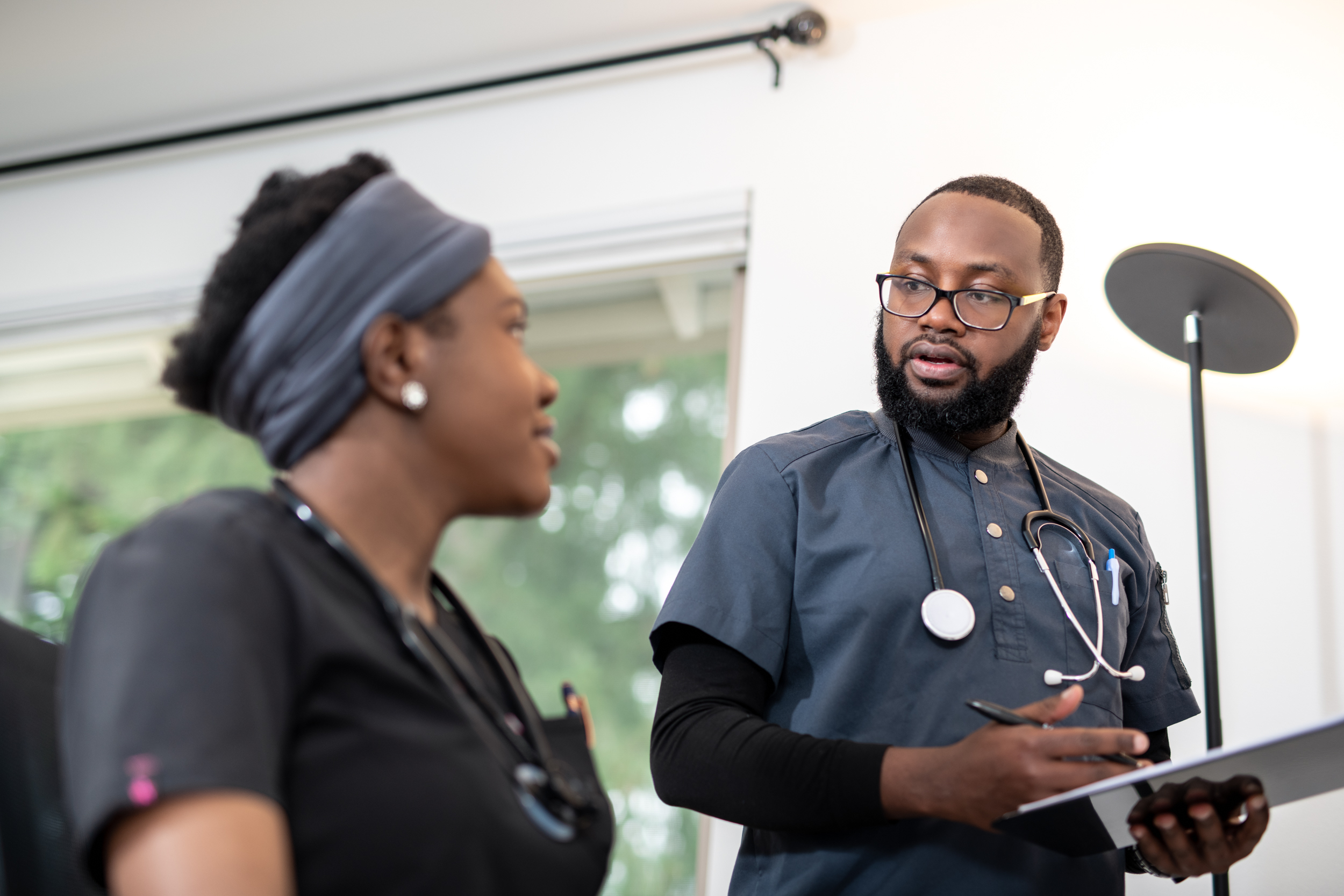
Every family who has placed a loved one in care knows the frustrating version of communication: "Everything is fine," a cheerful reassurance that contains no actual information, or updates that arrive days late. When a resident is medically complex, that kind of communication is not just frustrating — it is dangerous. Families need to know the truth about changes so they can participate in decisions.
At Edmonds Villa, the six-resident scale makes real communication structurally possible, and RN ownership makes it clinically useful. The person giving you an update is a nurse. The update is specific: here is what changed, here is what we think it means, here is what we are doing, here is what we are watching for. Questions get technically accurate answers, because the person answering them understands the medicine, not just the routine.
Adult children are often the ones coordinating a parent's care from a distance, and that coordination depends on being told the truth early. An RN-owned home is built to give you the kind of update you can actually act on. If that matters to you — and it should — it's worth asking on every tour how the home communicates when something changes.
Meet Sandra Namwase, RN: RN Ownership in Practice at Edmonds Villa

Sandra Namwase is a registered nurse and the owner-operator of Edmonds Villa. As the RN at the head of the home, she is not a remote figurehead whose license is listed on a form. She directs clinical care, oversees the delegation of nursing tasks, trains the care team, responds when a resident's condition changes, and is the person families talk to when they need straight answers.
Edmonds Villa is licensed by DSHS under license number #758617 and is licensed for up to six residents — a deliberate scale at which every medication schedule, care plan, and family conversation stays genuinely individualized. It sits in a quiet residential neighborhood in Edmonds, Washington, minutes from Seattle and within Snohomish County, and it has been built around the clinical realities Sandra knows from nursing: that complex conditions need protocols, precision, and someone who can think like a nurse at the moment a problem appears.
For families, choosing an RN-owned home means choosing an operator who has held the clinical responsibility that other homes outsource. It is the difference between a facility that manages your loved one's care and a home whose owner can personally assess, treat, and advocate for your loved one — starting from the moment you walk through the door. We welcome you to schedule a tour and meet us in person.
Frequently Asked Questions
What does it mean for an adult family home to be RN-owned?
An RN-owned adult family home is owned and operated by a registered nurse, meaning clinical decisions are made by someone with direct medical training and accountability rather than by an administrator who coordinates care. The owner designs medication protocols, oversees nurse delegation, trains the care team, and is the person families speak with when a resident's condition changes.
Why does nurse delegation matter in a high-acuity adult family home?
Nurse delegation is how Washington State legally allows trained caregivers to perform certain nursing tasks — such as administering medications or supporting tube feeding — under an RN's supervision. In an RN-owned home, that supervision is continuous rather than periodic, which means delegated tasks are performed correctly, documented properly, and reviewed by someone who understands their clinical significance.
Is an RN-owned adult family home more expensive than a standard care home?
Adult family home costs in Washington State generally range from $4,500 to $9,000 per month, and homes with RN ownership and high-acuity capabilities typically sit at the higher end of that range. The premium reflects a real difference in what is being provided: licensed nursing oversight, condition-specific protocols, and the ability to manage medically complex conditions that most standard homes cannot.
What happens when my loved one's condition changes suddenly in an adult family home?
In a six-resident home, caregivers notice changes quickly because they know each resident's baseline. Because the owner is a registered nurse, that observation can be acted on immediately — the RN can assess the situation, adjust the care plan, contact the physician, and decide whether emergency care is needed. This faster response often prevents unnecessary hospital transfers.
Can an RN-owned adult family home replace a skilled nursing facility?
For many medically complex seniors, yes. Homes like Edmonds Villa are licensed to provide high-acuity care in a residential setting — including Parkinson's management, dialysis support, and tube feeding — that most standard care homes cannot accommodate. Whether a skilled nursing facility is still needed depends on the resident's specific condition, which is why an assessment with an RN provider is the right next step.
Who is Sandra Namwase, RN, at Edmonds Villa?
Sandra Namwase is the registered nurse who owns and operates Edmonds Villa in Edmonds, Washington. As the RN at the head of the home, she directs clinical care, oversees nurse delegation, trains the care team, responds when residents' conditions change, and communicates directly with families. Edmonds Villa is licensed by DSHS under license number 758617.
How do I know if an RN-owned adult family home is right for my family?
The right choice depends on your loved one's medical needs. If they require multiple medications with precise timing, ongoing management of a complex condition, or specialized care such as tube feeding or dialysis support, an RN-owned high-acuity home is worth serious consideration. Contact Edmonds Villa to discuss your loved one's situation and to arrange a tour.
RN Ownership Is a Decision About Who Carries the Clinical Responsibility
Every adult family home is required to be licensed. Far fewer are run by someone whose medical training is part of the care itself. When your loved one is medically complex, that distinction is not academic — it shapes medication safety, how conditions are managed, how fast problems are caught, how staff are trained, and how honestly you'll be kept informed.
If you're evaluating care for a loved one near Seattle, ask the same question at every home you visit: who is the owner, what is their clinical background, and who makes the decisions when a condition changes? At an RN-owned home like Edmonds Villa, the answer is direct: Sandra Namwase, RN, is on site, clinically accountable, and ready to answer. Reach out to schedule a tour and see for yourself what RN ownership changes.